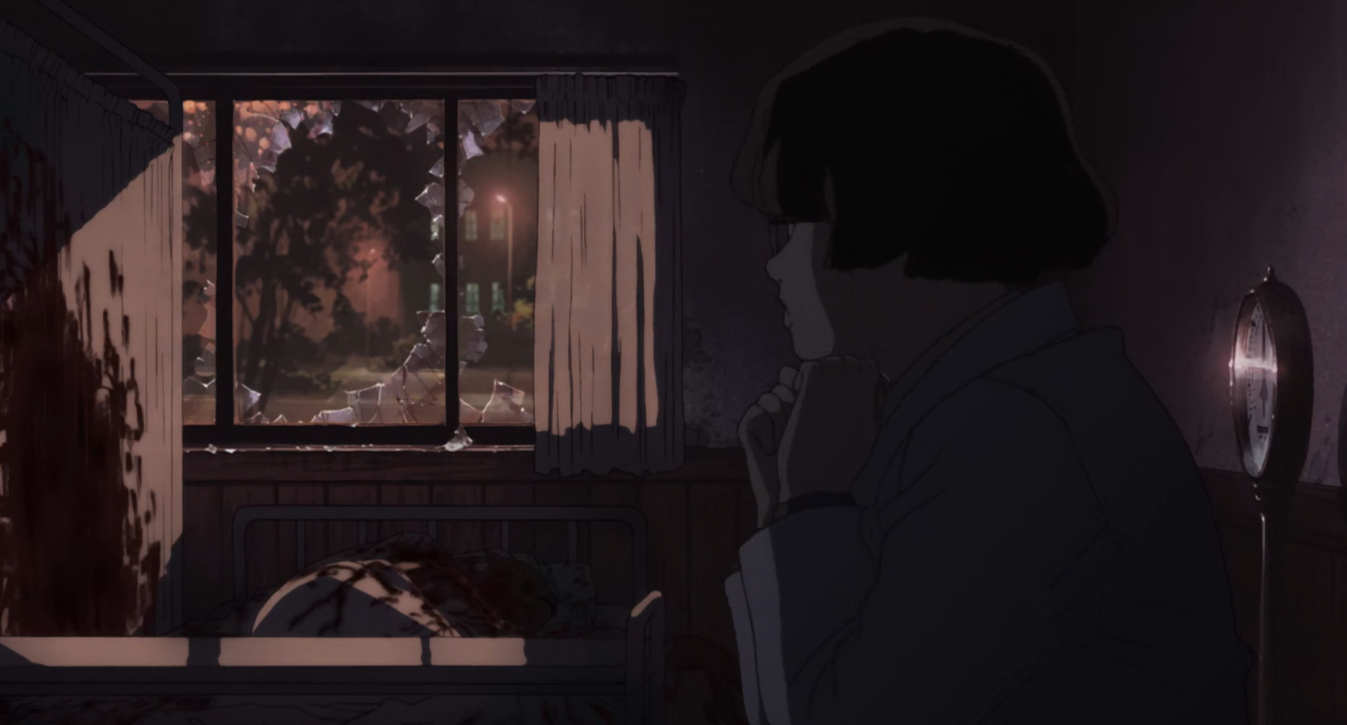
Recently, I had the chance to watch BLOOD: THE LAST VAMPIRE, a 40-minute anime film from the year 2000, directed by Kitakubo Hiroyuki. It was nothing short of a pure artistic and directorial flex, dripping with such raw and unapologetic vampirism as both visual and ambient presence. When main character Saya moves through space as an unflappable force, slicing demons with her sword as the nearby nurse screams in horror at what she’s witnessing, a drive exists underneath the surface through the sheer strength of its drawings and compositing decisions. Corridors seem almost paradoxically claustrophobic in their long emptiness, and the CG integration was uncompromisingly smooth during a period of anime that wasn’t known for it—and, depending on the production, still isn’t. The English voice actors they got in the Japanese dub of the film somewhat bumble their way through as, despite being American characters, they can’t quite escape sounding British. But it all felt at home. It lacks the kind of shounen action explosiveness we expect from the word “sakuga” (though explosions do happen in their glorious warm colors and heavy smoke), yet in doing so, it exists in a state of such tight control when masters of their craft operate at the height of their powers. BLOOD: THE LAST VAMPIRE reads like the perfect type of genre cheese, fully understanding the inherent appeal of what people would like in a story such as this one. It’s the sort of understanding that Mizushima Tsutomu in his Girls und Panzer, Shuumatsu Train, Prison School, and Mayoiga harnesses, which is why he’s one of my favorite directors working in the industry nowadays.
You’ll notice there’s one thing that I have not talked about in discussion of this film: the plot. From the first few minutes of Saya eviscerating a demon on the train, it seemed clear that the plot ultimately didn’t seem too important. That’s not to say that it’s UNimportant, but rather that the priority was on other things. To critique BLOOD: THE LAST VAMPIRE from the perspective of plot would undermine the care to detail that pervaded the film. It wanted to plant its foot in a vibe, and it stuck the landing perfectly. What does it matter that the demon’s origins are never explained, or Saya’s entire life story? But surely enough, one thing that you’ll often see if you look up various takes of BLOOD: THE LAST VAMPIRE are various complaints about the plot, that it doesn’t adequately tie up some loose ends or that it feels rushed, or doesn’t allow for characterization. Even if the writer makes a point of mentioning that the imperfect plot may not matter to certain viewers, these are often brought up as knocks against the film, as though there needed to be some prerequisite for the series to adhere to in order to be “great.”
I bring this up because, over the past several years, one aspect of my media consumption and critiquing that has undergone a reshuffling has been the prioritization of “the plot.” Back when I was younger, I found myself being overly concerned with whether the moments of the story made sense or if “the plot” was good. So many times, I would say something akin to “It looked nice, but it’s written poorly” or, to really bring up something that I’m certain many of us have said at some instance, “All style, no substance.” It was as though there was a keen focus on doing everything possible to break down a story (regardless of whether it was an anime or otherwise) such that the only thing that truly mattered was the plot. Sure, you could make something look eye-wateringly gorgeous throughout, but what does it matter if the plot isn’t any good? This chart below might be familiar to some of you.
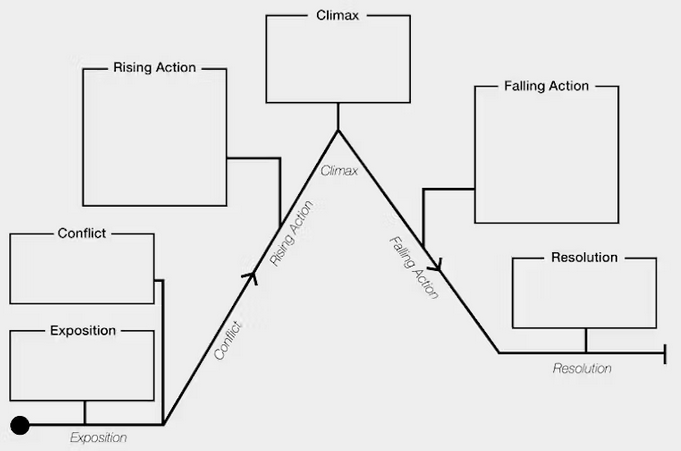
A part of this too is related to my own English and literary education, although it might be more accurate to say my lack of it. Being shown charts like the above instills in any student’s learning that storytelling had to follow a particular set of rules and standards. Even if it’s not this single chart precisely, I imagine that many of us have seen or learned something similar. You start with exposition / the beginning, introduce the conflict, gradually build up to a climax, and then resolve it before moving into the denouement or final resolution. As children, it admittedly does provide a helpful blueprint for those who want to understand the underlying structure of storytelling. Being able to understand the purpose of exposition, climax, and resolution does matter, and I wouldn’t want to insinuate otherwise. But learning this way unfortunately provides a far more rigid, “unfluid,” and unwelcome presence for what storytelling is inherently capable of doing. The above chart might provide you with a roadmap, but the manner by which you choose to follow it is just as, if not moreso, important. By placing the focus more on the “events” of the story moreso than how it goes about telling itself, it presumes that style is a lesser consideration. With this event-centric focus, we shouldn’t be surprised that a major portion of our criticisms deliberately casts down the importance of visual-acoustic execution. They become regarded as “less than” in the grand scheme, the lowest segment of the evaluative hierarchy.
It took years to unravel this mode of thinking from my own head.
Watching BLOOD: THE LAST VAMPIRE complicates the conventional understanding we’ve internalized because it refuses to conform to such reading. Within the anime’s understanding, it suggests that “plot” can not only be ancillary to other storytelling functions, but also that it is perhaps simply better to push it aside as a viewer. It’s not trying to make particularly grand aspirations in terms of its story. The actual meat often involves cheesy genre fiction that aspires to do little more than entertain. But if everything about what we supposedly value in art comes back to “the plot” and whether it’s good or not, then we will inevitably at times judge an elephant by its ability to climb a tree.
To put it another way – how can we take something seriously if it’s being so keen to tell us what does or does not matter, and we refuse to listen? I suppose there is an irony in trumpeting the diversity of anime while insisting that it must conform to restrictive modes of evaluative thinking.
Angels and Style
(unknown credit – Voogie’s Angel, episode 1)
Another series that follows a similar thought to BLOOD: THE LAST VAMPIRE is a little 3-episode 1997 OVA series called Voogie’s Angel. Primarily directed by the always-incredible Oobari Masumi, an invading force from outer space has more or less driven humanity under the sea, and with Master Teddy (yes, the most threatening name to ever grace anime) and their sadistic misanthropy, it’s a tall order for the Angels to stand against them. A bare-bones premise, to say the least. But if you take it purely at that value, you miss out on a story that takes three radically different forms depending on which episode you are watching. Especially considering that part of its developmental life overlaps with End of Evangelion (I’ll get back to this in a minute), it’s easy to understand why it ultimately took the route that it did.
The first episode feels like something that is far more geared towards a slapstick joie de vivre, with character dynamics, drawings, and situations in-line with the comedic. Watching Voogie watch the most stereotypical samurai action heroism flick and seek to incorporate that into her own battle technique offers movement and momentum, kinetic delight incarnate. Never quite as unhinged as something from the Imaishi or neo-Kanada school of animation, but something that offers flow and gravity through the act of being silly. Episode two functions as a transitional point not only in terms of tone, but also of visual styling. The character models have a more-uniform consistency, culminating in two decisive changes narratively. First, the characters’ cyborg-human existences are something anomalous, ushering their own existential crises. The second comes at the moment when the Angels are captured and must watch in agonized heartbreak as their leader is ruthlessly beaten.
In watching this all happen though, it’s never done for the sake of making us deeply care or identify / relate to the characters. Voogie’s Angel is not presented in such a way as to make us feel “attached” in the classic sense of attachment we have to our favorite fictions. Because its origins rest in genre cheese, it moves through the motions of its post-Evangelion existence (see? I told you it would come back!). But in doing so, it’s not trying to emulate that series or the End of Evangelion film. Instead, Oobari and everyone involved seek to find the inherent appeal of those motions in an unvarnished state and how they can be molded to new purposes. Voogie’s Angel does not do what it does for a plot – it’s for an expression.
(credit to Iso Mitsuo – Voogie’s Angel, episode 3)
Hence why episode three abandons nearly any pretense of the comic in favor of a sheer tour-de-force by some of studio Gainax’s veterans. Storyboarding the outing is Tadashi Hiramatsu, who himself would proceed to have a remarkable and ongoing career. His mastery already manifests in some deliciously realized sequences, black-and-white memories of the Angels before they became what they were. A sick child bleeding out on the floor, a militaristic invasion that rips a family apart, trapped within a space that chokes with its blankness and explodes in Iso Mitsuo’s sublimely destructive animation (see above), the list goes on. Here again though, the intent is not to forge deeply sincere sympathy or drive the viewer to engage in traditional senses of characterization / “the character’s journey” or plot. To take Iso’s scene as an example, even without audio, the girl’s agonized scream over the thunderous electricity and gushing winds is a level of expression that only a genuine master could create. You can hear it and sense it without actually hearing it. As a tool for making the plot “good,” it has virtually no might. As a tool for how Voogie’s Angel communicates to the audience what matters, it’s the most important scene of the whole series, and a serious contender for one of anime’s grandest displays.
I referred to “All style, no substance” as a phrase often lobbed at things like this. But I believe it would be more accurate to say that, in cases like this, the style IS the substance. While it is true that most of the media we consume is narrative in the sense of having a beginning, middle, and end, there is far more malleability within that structure than we give it credit for having. Voogie’s Angel, like BLOOD: THE LAST VAMPIRE, shows that expression as a raw power is its own wholly legitimate form of narrative. The events that transpire matter less than the “how” they are expressed beyond the level of writing / written theming. This is not limited to stuff like these two anime, either. K-ON! is occasionally maligned for being uninteresting plotwise, and Akira is at times derided as confusing, nonsensical, or mindless. This is despite both having visual-acoustic power that transcends the medium’s standard for their eras (or all eras), such that they practically beg to be seen and experienced beyond how we normally consider media.
The Solution
I titled this article “How We Got into Plot (And How to Get Out),” so what’s the solution? If you were willing to read to the end of this article and even vaguely entertain what I’ve written here, the chance is more than likely that you’re already on your way out. Certain anime are truly and inextricably linked to how they approach their work beyond the audience’s understanding of “the plot.” We must gradually learn to meet an anime on its own terms in this respect. If we can restructure or rewrite how we ourselves approach certain media pieces (and not just anime), or even ask ourselves, “Is the plot actually necessary for my enjoyment,” we’ll find ourselves being far more receptive and willing to see that which we would not consider before. It is, in the end, a form of nourishing our own curiosity, or even allowing it to be born anew.
It is not a form of “turn your brain off” – it is flicking on a new light switch.
If you want some “starter pack” anime for this kind of thing, 80s and 90s OVAs offer a huge variety of media that help with exposure to these ideas. You could simply pick one and dive straight in, but if you want a more-defined orientation, I can recommend the following:
- Iria Zeiram the Animation (1994 OVA series – great drawings and overall sense of action. They take their hunter licenses VERY seriously)
- California Crisis: Gun Salvo (1986 OVA – genuinely unique color design, as though it hypercondensed every 80s aesthetic it could and filtered it all through an alien camera)
- Bobby’s Girl / Bobby’s in Deep (1985 OVA – a haze of summertime listlessness and a supreme climax reminiscent of a-ha’s “Take on Me,” except that they were made at roughly the same time)
- R.O.D. Read or Die (2001 OVA version – strong battle choreography and use of paper as both visual texture and weapon)
- Vampire Princess Miyu (1998 OVA version – horror as atmosphere, solid use of character-space relations)
- Tetsuwan Birdy (1996 OVA version – expression and exaggeration through genderfluid “mahou shoujo,” and Gomez doing literally anything is fun)
(as a final aside, remember how I said that studying stafflists is a good way to find lineages in anime? Well, Iso worked on Evangelion, then animated for Voogie’s Angel, and eventually did BLOOD: THE LAST VAMPIRE. It’s all connected).
EDIT (3 June 2026): Hyperlinks added, formatting fixed.