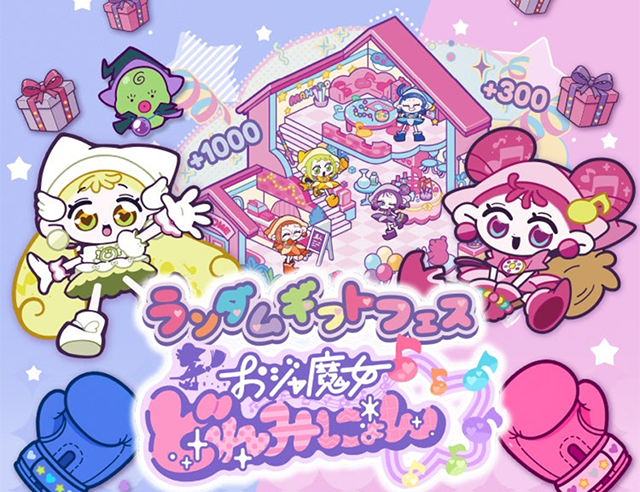
Hello everyone, today is a special day because we finally have an Ojamajo Doremi interview on the website! Bit odd considering this place is literally called Magical Stage. You’d think we’d be quicker in getting one of these on here! Animedia called this one a “Legend Anime Interview” and Hiromi Seki is definitely someone you’d be calling a legend. It’s not every day you end up being responsible for the best magical girl anime of all time but she did it and still does to this day.
We’ve also got Kaori Takayanagi who’s been at Toei Animation since at least 2012, handling advertising for Nijiiro Hotaru – Eien no Natsuyasumi (a very good film you should definitely watch and read about), but she’s been a producer as of late, having been on the production committee for Looking for Magical Doremi and being involved with production on a couple of Precure’s recent films.
Also, if you are reading this and you’ve not watched Ojamajo Doremi yet, may I suggest doing that at some point in the near future? You could watch 20 seasonals or you could be watching one of the best anime ever made! Pretty easy decision in my opinion.
Anyway, let’s look at these interviews!
Translation by “nui”, Editing by me – Legend Anime INTERVIEW – Hiromi Seki and Kaori Takayanagi was originally published in Animedia in June 2026.
Ojamajo Doremi Series General Producer: Hiromi Seki (関弘美)
Affiliated with Toei Animation. General Producer for the Ojamajo Doremi and Digimon Adventure series, planning for Fresh Precure!, Heartcatch Precure!, and more.
Doremi Was a Battle Every Year
Interviewer: Reaching its 25th anniversary, Ojamajo Doremi is showing a huge surge of excitement with new videos and such. Back when it was being produced, did you think it would become a series loved for this long?
Hiromi Seki: For the TV series we had 4 seasons (4 years), and after that we also made an OVA series called Ojamajo Doremi Na-i-sho. It’s truly something to be thankful for that even after so much time has passed, we are still receiving your support. When the series first started, every year was a battle, and we were thinking things like “How many years can we keep Doremi going?” But since we started the anime when Doremi and the others were in the 3rd grade, we really wanted to properly portray them all the way until they became 6th graders and had their elementary school graduation ceremony.
Interviewer: Despite being a show aimed at girls, Doremi was also a highly popular series with boys, wasn’t it?
Seki: We actually noticed fairly early on in the first series that it was being supported by boys as well. Back then, we were getting solid TV ratings, and the numbers were even broken down by age groups. The TV programming block at the time went from the Super Sentai series to Kamen Rider, followed by Doremi, and then if you changed the channel, Digimon Adventure would start… that was the flow. From a boy’s perspective, it might have just been a bridge until Digimon started, but once they actually started watching it, exactly as we planned (laughs), a lot of kids got hooked, and we really felt the response.
build note: Ojamajo Doremi was in the “nichiasa” program block on TV Asahi on Sundays at 8:30am. It’s the same block Precure has occupied since it began. Super Sentai (rip) and Kamen Rider are the other occupants of the block. Also Seki-P sure is devious sandwiching Doremi between the tokusatsu and Digimon eh!
The Setting and Story That Grabbed the Hearts of Elementary Schoolers
Interviewer: Ojamajo Doremi gathered support from elementary schoolers in general, regardless of gender. How do you perceive the reason for that?
Seki: I think it’s because our elementary school viewers could watch it with a sense of empathy. Back then, there weren’t many anime with elementary school protagonists. Most shows were either for really small children or featured protagonists in junior high or older. It just so happened to be an era where there weren’t works aimed at elementary schoolers. On top of that, the tokusatsu shows airing before Doremi featured older guys transforming and fighting, right? They are an “object of admiration,” not an object of empathy. On the other hand, the ones appearing in Doremi are elementary schoolers of the same age group and roughly the same proportions as the viewers. If you exclude the magic and the stuff around the MAHO-Dou, what they are doing is no different from real elementary schoolers. Girls telling on boys like, “The boys slacked off on cleaning!” at school, getting super into handmade crafts or cardboard box art, boys and girls clashing with each other, and then suddenly the whole class coming together to do their best at sports day. The characters in Doremi are doing their best every day just like them, so we were confident that any elementary schooler would be able to enjoy Doremi with a sense of empathy.
Interviewer: What do you think is the biggest charm of Ojamajo Doremi, Seki-P?
Seki: The fact that all the characters are “ordinary.” I think that’s its biggest charm. They don’t have heroic abilities, and they absolutely weren’t born under a star of destiny. Starting with Doremi, almost all the characters are very ordinary people. I think that’s what’s so wonderful and great about it. Back when we were producing the anime, to depict that “ordinary” nature, all the staff members would reminisce about our distant childhoods while creating the stories. However, when we conducted a survey of actual elementary schoolers as part of the production process, we realized something. We realized that “children’s emotions are universal.” When we asked elementary schoolers in the survey “What recently moved your heart?”, we got a lot of answers like, “I was so happy I rode my bike without training wheels for the first time,” “I was happy my friend liked the same things as me,” “I was so sad my pet died”… and those were almost exactly the same things we felt when we were kids. We learned that the fundamental sensibilities of today’s kids and us kids from 30 years ago haven’t changed at all. Even if the environment surrounding kids or the trends change, the sensibilities the kids themselves possess don’t change in any era. If that’s the case, we understood that we just needed to make a drama that stays close to those universal emotions.
However, there was actually another bottleneck. “How to get elementary schoolers to believe in magic” was our other challenge. Around the middle grades of elementary school, kids are at an age where they start faintly doubting the existence of Santa and start thinking “There’s no such thing as magic or superpowers.” On top of that, flip phones were spreading in society, and the internet was becoming more familiar. Amidst that historical backdrop, how to get them to watch an anime themed around magic was a big challenge. So, what we came up with was “Magical Spheres,” inspired by playing shop. In the world of Doremi, you need “Magical Spheres” to cast magic, and those “Magical Spheres” can only be obtained as compensation for labor. We established that kind of rule. “You can’t use magic freely unless you work” is almost synonymous with not getting your allowance unless you help out around the house. When you talk about the middle grades of elementary school, they are at an age where they can go shopping clutching their own allowance. By incorporating settings that align with that kind of reality, I think magic became something more real and familiar to them, and they were able to watch Doremi every week with a sense of empathy and affinity.
If You Were to Make a New Doremi in the Reiwa Era!?
Interviewer: If you were to make a new Ojamajo Doremi now in the Reiwa era, what kind of thing would it be? Do you have any concepts in mind?
Seki: I can’t say anything concrete yet, but we are steadily working on concepts. Actually, putting out some sort of Doremi video or content every year is partly a way of gathering information in anticipation of a new Doremi work. We check pretty seriously whether our fans from back in the day are watching, or if it’s becoming an approach to demographics who don’t know Doremi. If we were to feature some kind of item in a new work, it would probably be good to have something a little more futuristic than the current era. It’s good for the tools that appear in anime to be a little ahead of the times and tickle their curiosity. Also, I think the content of the work will change greatly depending on whether it airs now or in two years.
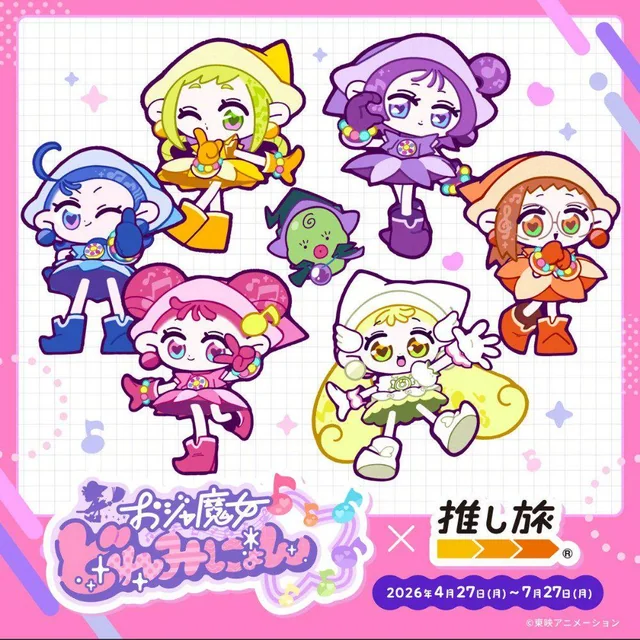
Interviewer: The newest work in the Doremi series is Ojamajo Doremi Nyon. It is a short video that started as one of the 25th-anniversary plans, but in addition to the pop character designs, it’s also a hot topic for being the first vertical anime in the series. Please tell us the secret story behind the production of this anime.
build note: Vertical Anime are anime designed to have a “vertical” aspect ratio, in this case, an 9:16 aspect ratio which is what’s used on social media like TikTok. Also Doremi Nyon hasn’t actually got an AniList page yet, someone should probably fix that…
Seki: It’s the first vertical anime for Doremi, made with the Reiwa era’s video viewing style in mind, but from the creator’s side, there was a change in direction that was almost like a revolution. First of all, the screen is vertical, so naturally the storyboards also become vertical, and more than anything, the length of the video is drastically shorter than horizontal anime. For example, one episode of a TV anime is just over 20 minutes net, and a movie is about 70 to 120 minutes. On the other hand, few short videos exceed 1 minute, averaging a dozen seconds or so. As for the user’s video retention time, it’s a world where a long time is 2 to 3 seconds. Getting a short video watched to the end is an incredibly rare thing in itself. Amidst all that, Ojamajo Doremi Nyon is getting watched for an average of about 4 to 6 seconds. This is thanks to the skill of our planning producer, Kaori Takayanagi-san. Takayanagi-san watches a tremendous amount of video, analyzes trends and countermeasures for each genre, and is someone who can apply that to marketing. Seeing Takayanagi-san’s work, I myself learned a lot too.
Interviewer: Please tell us your ambitions for Ojamajo Doremi heading towards the next 30th anniversary.
Seki: Will it end just as an ambition, or can it be realized…? Whether the next development for Ojamajo Doremi comes true or not depends on what we are doing right now. To put it in MAHO-Dou terms, right now we are in the middle of saving up our Magical Spheres. I think that if those savings pile up, we’ll be able to land in a good place. It really feels like I’m a real-life Majo Rika. Like, “You guys, get to earning~!” (laughs).
Interviewer: Finally, please give a message to the fans who have continued to love Ojamajo Doremi.
Seki: Ojamajo Doremi is a very, very precious work to me that I want to keep going from here on out, even if it changes shape in various ways. While the clothes they wear might change, the core worldview that forms its bones will remain firmly consistent. I hope we can deliver more of Doremi and her friends to you, like “We tried dressing up a bit” or “We tried acting a little bad,” so I would be happy if you continue to enjoy it.
Ojamajo Doremi Nyon Planning Producer: Kaori Takayanagi (高柳香織)
Affiliated with Toei Animation. Major works she’s handled include being the License Manager for the Precure Series, Product Planning Manager for THE FIRST SLAM DUNK, and more.
A New Form of Doremi to Enjoy Casually
Interviewer: The newest work in the series and the first vertical mini-anime, Ojamajo Doremi Nyon, is currently enjoying a popular run online. Could you tell us what sparked its production?
Kaori Takayanagi: Up until now, I’ve been in charge of product planning and manufacturing, opening store locations, and licensing sales. Among our customers, we heard voices saying things like, “I know Ojamajo Carnival!! really well because of the Heisei boom and how popular it is at karaoke, but the TV series is so long, and it has this image of being an older show. I just don’t really have a reason to start watching the anime or buying the merch.” Because of that, I felt it would be great if they could interact with Doremi much more casually through touchpoints like short videos or goods, and hopefully, that would become a trigger for them to learn about the series. Right around then, Producer Hiromi Seki reached out to me saying, “I want you to try thinking up a new Doremi that people of the current generation can participate in.” So, we formed a team with young staff members in the company who are sensitive to trends and know a lot about SNS (social media), and that’s how this project started.
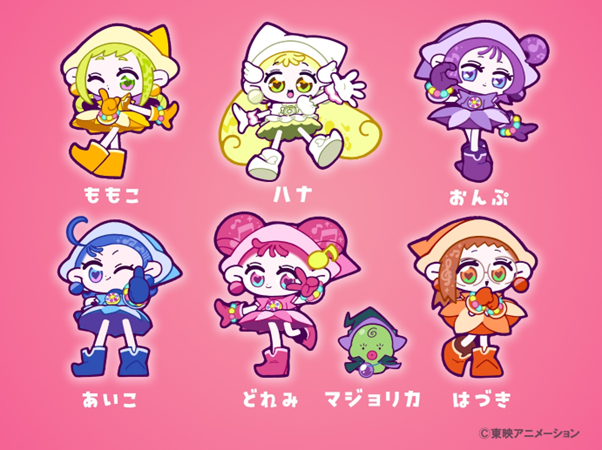
Interviewer: The setting for Ojamajo Doremi Nyon is that Doremi and her friends are beings born from pictures drawn by Hana-chan and her tears. What was the reason for making them characters who aren’t the actual characters themselves?
Takayanagi: The story for Doremi and her friends in the TV series already ended once with them saying their goodbyes to Hana-chan. We did have this desire for it to be a continuation from there, but after a farewell with that much resolve, we felt it would be wrong for them to just easily reunite. The theme for this work is “Let’s play together!”, but we figured that if it’s the mischievous Hana-chan creating these new versions of Doremi and her friends, they would definitely have fun and casually handle modern smartphones without any trouble, make the kind of everyday “that happens, right?” mistakes we do, and play around in ways unique to SNS. We put our hopes into it being something that viewers can also watch without straining themselves, just casually, and have it become a little breather for them.
Interviewer: Please tell us about the future developments for Ojamajo Doremi Nyon.
Takayanagi: This work is currently being released irregularly, but there’s no set story, and we want it to be a work that evolves to match the trends of the moment and the voices of the fans. Also, it’s progressing not just on screens, but at the same time in stores and event venues. We want to be more conscious of that “sense of unity between online and offline,” and we’re hoping to have fun building this up together with company members and all the fans. We would absolutely love it if you guys could give us your opinions on SNS and things like that!