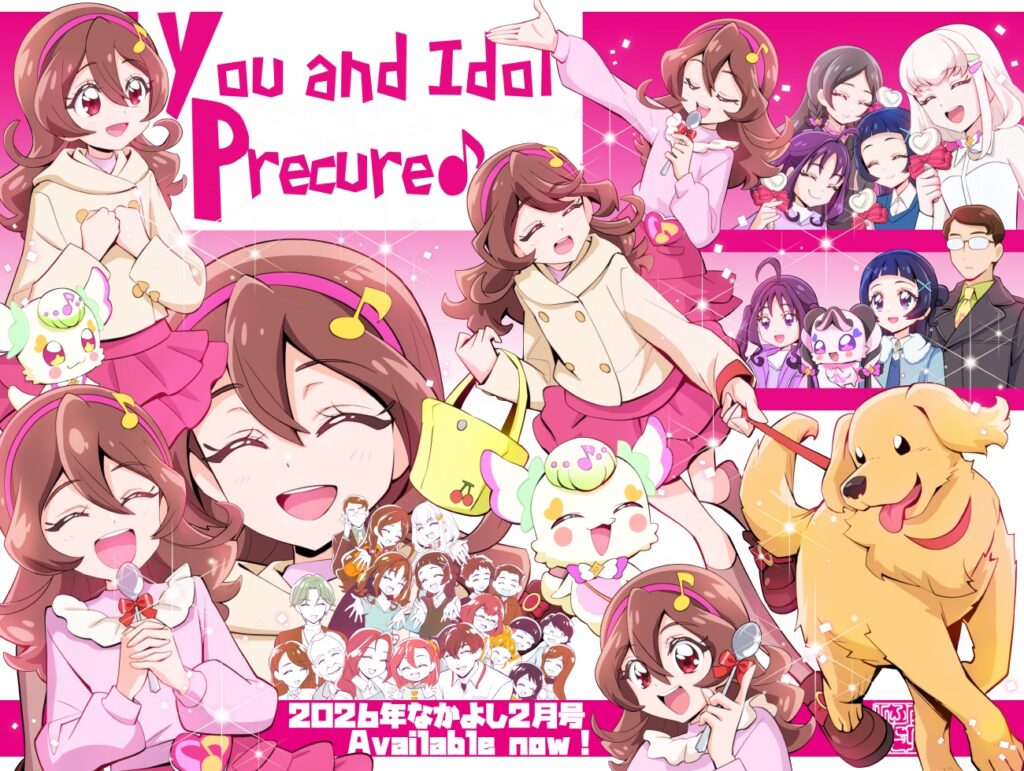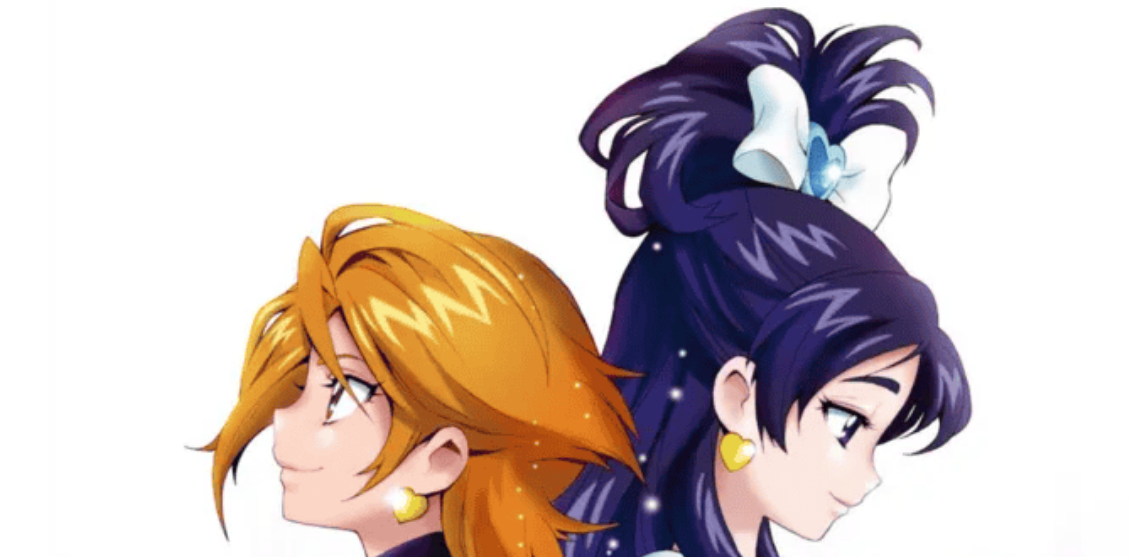
Hello everyone, we’ve got another old interview here coming from the Febri Precure 15th Anniversary Book. This interview is of Futago Kamikita (Mina Kamikita and Kisa Kamikita), the twin sisters who are known for drawing and writing the Precure manga series that accompanied the anime since its inception in 2004. In January 2026, the Kamikita Twins published their final issue of their Precure manga, ending a 22 year run. They’re both publishing art on Twitter though!
A few years ago, I wrote one of my previously famous long threads on Twitter about the Kamikita Twins which you can read here, talking in broad strokes about their history working on anime and the thread also includes a list of credits that I was able to collate with all of their known works.
That Febri book does have another special interview with another very old person who worked on Precure actually. Maybe that’ll appear on the site soon, who knows!
Translation by “nui”, Editing by me – Futago Kamikita Special Interview – Febri Special Feature was originally published in the Febri Precure 15th Anniversary Book in October 2018.
Futago Kamikita Special Interview
From the very first series Futari wa Pretty Cure to the latest HUGtto! Precure, the twin manga artist sisters Futago Kamikita have been handling the manga adaptations. The “everyday lives” of the Precures drawn with their beautiful lines give us a glimpse into a world with a slightly different flavor from the TV series. We asked them via email interview how they have watched over the challenges and evolution of Precure.
When we watched a rerun of Yatterman, and fell in love at first sight with Yoshitaka Amano’s westernized character designs.
Interviewer: First, I would like to ask about your career before you started working as manga artists. Were there any manga or anime you were hooked on as kids? Also, do you remember the first comic book you bought?
Kamikita: After graduating from junior college, we joined the personal agency of Hiroshi Sasagawa, the general director of the Time Bokan Series at Tatsunoko Production.
When we were kids, rather than being deeply hooked on one specific thing, it felt like we just watched and read anything. As for the first comic book we bought… what was it, our memories are already blurry on that…
Interviewer: Did you like drawing since you were kids? Who are some of the creators or directors who have influenced you so far?
Kamikita: It seems we’ve been doodling since we were little. There are still photos left of us drawing on walls and floors.
We’ve been influenced by Yukari Ichijo, Chiki Ooya, Takumi Nagayasu, Akira Toriyama, Hisashi Eguchi, Yumi Tadai, Naoko Takeuchi, Runrun Yamamoto, Shinichi Sakamoto… we are honestly influenced by so many manga artists that we couldn’t possibly write them all down.
And we were also drawn to the westernized art styles of American comics, bandes dessinées, overseas animations, and Tatsunoko anime.
We are also very inspired by the art of illustrators. We love Baron Ueda and Kaori Wakamatsu.
In Precure, every time the reference materials arrived, we were astonished by Akira Inagami’s cute art style and design skills. We were particularly overwhelmed and fascinated by the enemy character designs.
Interviewer: You mentioned that you started working at Tatsunoko Production when you moved to Tokyo for junior college, but when did you decide to make “drawing” your career? Was there any specific trigger?
Kamikita: When we were in elementary school, we would see anime merchandise and vaguely think, “It would be nice if I could do a job drawing pictures like this.” However, we didn’t have any concrete hopes or take any action, and just spent our time really aimlessly. But one day while attending junior college, we watched a rerun of Yatterman and fell in love at first sight with Yoshitaka Amano’s westernized character designs. We wanted to draw for the Time Bokan series no matter what, so we knocked on the door of Tatsunoko Production.
Interviewer: What kind of work did you do at Tatsunoko Production? Has that experience been put to use since then?
Kamikita: Even though we knocked on Tatsunoko Production’s door, they told us they weren’t currently hiring. But, far from turning us away, they were kind enough to introduce us to the personal agency of Hiroshi Sasagawa, where we ended up working on character designs and merchandise illustrations. Even though we had been doodling since we were little, we hadn’t learned the basics of art, so we ended up learning a lot about sketching and design, which has become the foundation for our work.
Interviewer: After returning to your hometown, we heard you started drawing manga. Was there a trigger for that? How did you end up in charge of the Precure series manga adaptation?
Kamikita: Even after returning home, we continued to do anime-related work, but we wanted to expand our scope of art jobs, so we challenged ourselves with manga, which we could do even from the countryside. Winning an award for a manga we submitted led to us drawing short stories for seinen magazines and the like. After that, wanting to draw in the shoujo genre, we jumped into Nakayoshi.
And it was entirely lucky timing… even now this encounter seems mysterious to us, but right around the time the serialized manga for Yobarete Tobidete! Akubi-chan was ending, we were approached with, “Would you like to try drawing the manga adaptation for a new anime?” We had absolutely no idea back then that it would become such a massive hit series, or that we would be in charge of the manga for so long.
Interviewer: Do you remember your impressions when you first saw Precure? Had you ever watched Sunday morning anime aimed at young girls before that?
Kamikita: While we were thinking that a buddy format might be the way to compete with the appeal of large teams like Sailor Moon, we were told about the Futari wa Pretty Cure project and thought it sounded interesting. And the actual footage we saw far exceeded our expectations. Nagisa and Honoka’s charm, and the battles after transforming into Precures! We were so surprised that adults could get this excited watching an anime aimed at little girls!
We were actually relatively out of the loop with the anime scene, so we hadn’t watched the Sunday 8:30 AM anime block before.
Interviewer: How do you proceed with the manga adaptation process? Could you explain as specifically as possible, like reading the script and picking episodes?
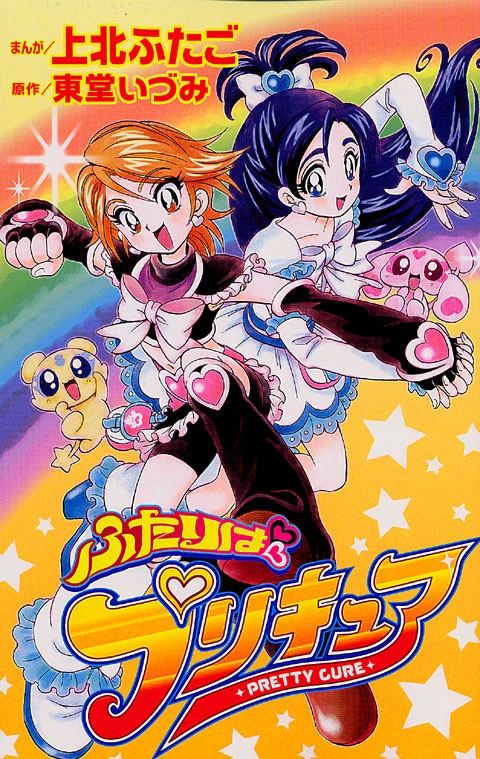
Kamikita: First, we extract impressive character episodes from the script, compare the broadcast dates with the book’s release date, and consider how much we can include without giving away early spoilers. Then, we flesh it out into a single story and create a plot.
Since it’s a monthly serialization with 9 pages a month, it’s impossible to follow the anime’s flow step-by-step. Even when introducing a new character, if balancing the timing or explaining the setting and emotional changes would take up too many pages, we monitor how the story unfolds in later scripts. Then, after some time has passed, we might have them suddenly appear like, “We got a new friend!” There are quite a few cases where we have to give up on featuring a character entirely, even if they are important in the anime.
Interviewer: What was the hardest part of writing the first series, Futari wa Pretty Cure? Also, where did you feel a sense of accomplishment while drawing it?
Kamikita: The struggle was figuring out what kind of stories were possible when creating original everyday episodes. With the Nakayoshi editor-in-chief’s instructions, the manga adaptation was set to be drawn in the rom-com genre. So we drew it while maintaining a delicate, not-too-close, not-too-far distance, searching the scripts to see where Nagisa and Fuji-P-senpai’s romance was heading.
We felt a sense of accomplishment during Futari wa Pretty Cure Max Heart, when we created the story of throwing a surprise birthday party for Honoka.
Kamikita: We felt a real sense of accomplishment in the second year, Futari wa Pretty Cure Max Heart, when Hikari Kujo joined, and we created a story about throwing a surprise birthday party for Honoka. It brought out the bittersweet feeling of Nagisa and Honoka’s feelings for each other crossing wires, and it became the catalyst for creating stories that deepened Nagisa and Honoka’s relationship.
Interviewer: Since then, through Futari wa Pretty Cure Splash☆Star, Yes! Precure 5, and so on, Kamikita-sensei, you’ll have continued the manga adaptation up to the currently serializing HUGtto! Precure. Please name about three titles that stick out in your memories.
Kamikita: We are incredibly grateful and thankful to have been allowed to continue handling the manga adaptations. The one that stands out in our memories the most is the first, Futari wa Pretty Cure. We were thrilled wondering what kind of show it would become. The anime’s popularity accelerated, movies were produced, and the Precure world kept expanding. Our workload increased too, like getting to publish entirely newly drawn standalone volumes, so those were hectic but happy days.
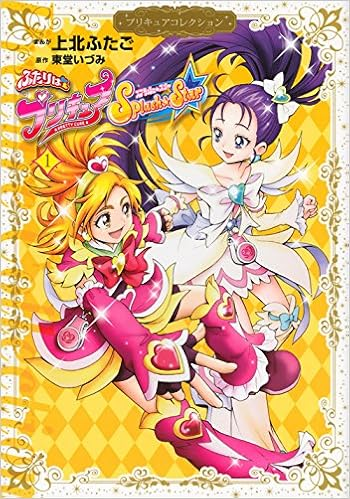
Futari wa Pretty Cure Splash☆Star is also deeply memorable. We were nervous when we heard the characters would be completely new, but Saki and Mai were both so cute and hardworking that we immediately fell in love with them. The manga’s page count was increased to 16 pages, so we were able to include battles, albeit short ones, in developments following the anime. That gave us a rush, feeling like we were fighting evil right alongside the anime.
And then, with the following Yes! Precure 5, we were surprised by the large group, but we had fun creating harmonious, everyday stories for a team where everyone’s individuality was a joy.
…When looking back in order like this, every single work is memorable, so it’s truly hard to choose which ones.
Interviewer: The character designs and motifs change every year in the Precure series. What points do you pay attention to when drawing the characters? The art style direction, like proportions, also changes depending on the series. How do you capture the art style?
Kamikita: The animators who smoothly transition into drawing the newly renewed characters every year are amazing, aren’t they? We struggle every series to make our drawings resemble the character designs as much as possible.
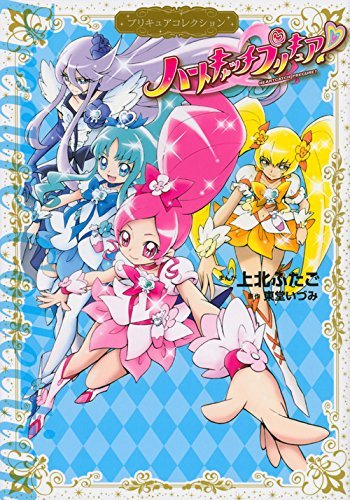
The first thing we look at is the level of deformation. Even if the body proportions are about the same, the way the human body is drawn varies greatly, from Inagami Akira-shi’s distinctly cute style to the delicate feel of the female designers. It’s very educational.
nui note: In the Japanese anime and manga industry, the term used is deforume (デフォルメ), which is a loanword adopted from the French word déformer. It translates closely to stylization, exaggeration, or simplification. “Deformation” refers to exactly how an artist intentionally bends realistic human proportions to create an appealing, distinct art style.
Among them, the most original was Yoshihiko Umakoshi’s simple yet sharp line deformation in Heartcatch Precure!. KiraKira☆Precure A La Mode also had designs that followed that trend, and it was fun to mimic.
The way lines are drawn differs depending on the designer’s personality. In shows like Heartcatch Precure!, the backgrounds were drawn in a unique deformed style to match the character designs, so everything is a learning experience.
build note: Futago Kamikita noticing that Kirakira Precure A La Mode had similar designs to Heartcatch is interesting because Character Designer Marie Ino and Umakoshi worked together at Studio Cockpit and now at Studio Shiokaze. There’s quite a bit of influence there!
Interviewer: Also, are there any areas you specifically pay attention to when fleshing out the characters?
Kamikita: Because we have to express things in a few pages, we might slightly exaggerate character elements, strengthen the relationships between characters, or over-exaggerate expressions, but we try to ensure these act as a “plus alpha” that adds to their charm.
nui note: “plus alpha” (プラスアルファ or purasu arufa) is a common Japanese idiom that translates to “something extra,” “a little something more,” or “an added bonus.” It is actually a wasei-eigo (Japanese-created English) term. It originally comes from mathematical equations where “alpha” (α) is used to represent an unknown variable. Over time, it evolved in everyday Japanese to mean adding an unspecified but positive extra value to a baseline.
In this context they mean that any changes they make to the characters’ expressions or relationships shouldn’t just be random. Because they have limited pages to tell a story, they have to push the characters’ reactions or bonds further than the anime might in a single episode. However, they want to make sure those exaggerations act as an added layer of charm that makes the manga adaptation special. They are aiming to give the readers the core Precure characters they already love, plus a little something extra that you can only get from their specific manga storytelling.
In the manga, we place great importance on how to depict the bonds between friends.
Interviewer: The story’s content and the themes it explores change every year in Precure, but what is the one thing you cherish amidst all that? What do you think is the unique point that defines the Precure series?
Kamikita: “Girls teaming up with friends, mustering their courage to stand up and fight evil to protect their everyday lives”… I think this is the common thread across the series. The stories in Precure use the “enemy organization” to symbolize the absurdities and evils of the world. Standing up firmly, even as girls, to object to unreasonable treatment and taking action is steadily becoming the common sense of today.
In the manga, battles with enemies don’t appear, so we place great importance on how to depict the bonds between friends.
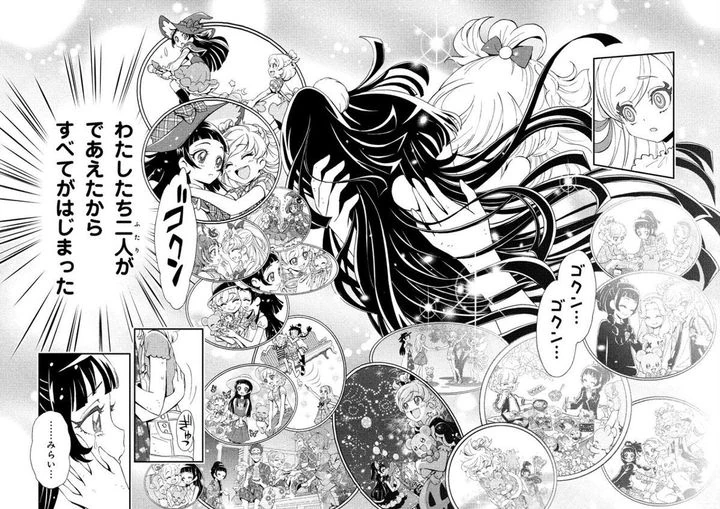
Interviewer: Speaking of the Precure series, the battle scenes are also important. What do you pay attention to when drawing fights?
Kamikita: In recent years, we hardly draw battle scenes anymore.
At the beginning of the serialization, it was an everyday slice-of-life route without battles. But when we published the entirely newly drawn standalone volume (a re-edited compression of half a year of the anime), we had to draw battle scenes for the first time. We realized how tough it is to express the powerful animation of the anime in a single, colorless, soundless illustration, so we studied by looking at action scenes in various manga.
Expressing the pain and the textures of breaking objects is of course important, but we learned that we really have to draw the emotional side properly so it doesn’t just end up being a contest of strength.
Interviewer: Kamikita-sensei’s manga versions are also really enjoyable for their lively everyday scenes. Is there anything you keep in mind when drawing daily life?
Kamikita: We try our best to make sure we don’t deviate from the characters’ basic desires or their positions and roles within the work.
Interviewer: The serialization runs parallel to the broadcasts, but are there things you realize upon watching the show air?
Kamikita: There are many scenes and lines that get changed, cut, or added from the script, so comparing them is a great learning experience. We often get goosebumps, moved by the directing skills, thinking, “Wow, this single line of text from the script turned into this footage! It’s shown in such an appealing way!” Also, we frequently revise the manga using the anime as a reference for things like how characters speak or how their expressions break.
Interviewer: We’d like to ask about your work environment. We hear that the two of you work together, but how do you divide the tasks?
Kamikita: It’s a collaborative process where we brainstorm together and help each other out. We divide the tasks as we see fit and somehow manage to get it to completion.
Interviewer: What do you pay particular attention to when adapting a full-color TV anime into black-and-white manga manuscripts? We hear you’ve introduced a digital environment; what are the pros and cons of digital versus analog?
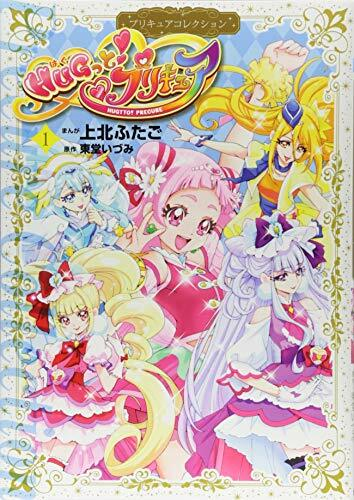
Kamikita: The thing we pay the most attention to is making sure the impression doesn’t differ from the original coloring. If you convert color directly to monochrome, it becomes a dull, sleepy image without contrast. So, we replace the colors with about five different shades, including black and white. Because it’s a shading replacement that also considers the balance of the whole team, it’s a series of trial and error every time a new Precure begins.
For our black-and-white manga manuscripts, everything up to the inking is analog, and all the finishing work after that is digital. For color illustrations, we increasingly do everything digitally from the inking stage onward.
The pros of digital are that it saves time, you can redo it as many times as you want, and for color work, it can produce unexpected color schemes or filter effects. Not needing to manage art supply inventory and being able to send it off immediately upon completion are also huge benefits. As for the cons, the only thing we can think of is that you can’t work if there’s a power outage.
The pro of analog is… perhaps the physical sensation of actually finishing the manuscript right in front of you. We feel it makes it easier to grasp the sketch and the overall picture. We also think there’s value in its existence as the only one of its kind in the world. The cons are just the opposite of the digital pros.
Interviewer: With HUGtto! Precure, the Precure series has entered its 15th year. Looking back, what kind of existence has Precure become for Kamikita-sensei?
Kamikita: It has completely blended into our lives, occupying the vast majority of it, and is an indispensable presence. Since starting Twitter last year, posting illustrations and retweeting information from everyone involved has made our days with Precure even more immersive.
Interviewer: Finally, please give a message to the current generation enjoying Precure, and to the fans who have loved Precure up until now.
Kamikita: Precure repeats its renewal every year, continuing its evolution and challenges. As two fans ourselves, we want to enjoy seeing where the stories and themes of Precure go from here on out together with all of you.
And to the fans who have watched over and supported Precure for so long, the depth of your love is truly wonderful. Please continue to cry and laugh together with Precure, and fully enjoy your days with enriched hearts. We’ll do our best on the manga version too, so please continue to support us.
Profile: Futago Kamikita 上北ふたご
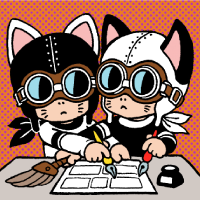
Born on August 11, Leo, Blood Type B. From Kochi Prefecture. In 2002, they had their first regular serialization in the main Nakayoshi magazine with Yobarete Tobidete! Akubi-chan. Their representative work includes Futari wa Pretty Cure, among others. True to their name (futago means twins), they are twin sisters who work on their creations together. Their hobbies include watching movies and hunting for candy toys.