I. Spoil and trigger warning disclaimers
Potential spoilers for any of the series discussed in the context of this article may affect readers’ inital receptions of works. Especially for the shows or franchises Yuri Kuma Arashi and Puella Magi Madoka Magica and its third movie, Rebellion. Trigger warnings: the article discusses such notions as misogyny, transphobia, transmisogyny, lesbophobia…
II. Abstract
Henshin is a type of animated sequence, often reoccurring throughout anime shows characterized by limited animation and productions that are dictated by economic imperatives. Also called transformation scenes, one can read several meanings in them, with interpretations ranging from symbolism, to transcendance, liberation, agency, empowerment, gender role subversion, stereotypes, proximity to cosmic elements and more. We will first delineate a model of henshin after a quantitative analysis of various scenes across works with excerpts featured on Sakugabooru. Then, a comparative analysis will help us compare our model more concretely. Yuri Kuma Arashi and Madoka Magica are two series using henshin scenes, in layered, symbolic narratives with homoeroticism as a key component of their subtexts. The works also can have polarized receptions, for instance when it comes to incarnating a form of male gaze, due to having men as original creators. We will therefore be paying attention to cuts and frames that make up the scenes with techniques such as framerate modulation [1], resituating the transformation scenes as liminal experiences [2], as well as analyzing both the effect of henshin on the viewer and on the character, through the renewal of the sakuga paradigm in various anime circles, so as to discover a poetic potential in representing queerness.
III. Quantitative model of henshin
| Tags | Occurrences and representative percentage (n = 1615) | Nature (content or franchise) |
| Henshin | 1615 (100%) | Content |
| Animated | 1613 (99%) | Content |
| Effects | 1310 (81%) | Content |
| Hair | 499 (31%) | Content |
| Smears | 459 (28%) | Content |
| Character acting | 255 (16%) | Content |
| Creatures | 250 (15%) | Content |
| Smoke | 185 (11%) | Content |
| Rotation | 178 (11%) | Content |
| Lighting | 175 (11%) | Content |
| Impact frames | 171 (11%) | Content |
| Fire | 162 (10%) | Content |
| Precure | 160 (10%) | Franchise |
| CGI | 124 (8%) | Content |
| Fighting | 102 (6%) | Content |
| Sparks | 92 (6%) | Content |
| Digimon | 88 (5%) | Franchise |
| Liquid | 88 (5%) | Content |
| Wind | 87 (5%) | Content |
| Debris | 85 (5%) | Content |
| Mecha | 85 (5%) | Content |
from the 40 most recent entries. [3] Emilia Lilith-Lolita Hoarfrost, September 17, 2026.
Sakugabooru is a website inheriting the image board structure, notably analyzed by scholar Hiroki Azuma when he discusses socialization in the otaku community [4].
“[…] The otaku’s attitude toward a work may be animalized, i.e., governed by a simple logic of lack and satisfaction. […] Otaku are also known to be quite sociable. Far from avoiding contact with others, [they] engage in diverse modes of communication, such as online chats and bulletin boards as well as conventions and “off-line meetings” […] There [are] complex relationships at work, such as desiring the desire of the other [:] regardless of their generation, [they] compete with each other in collections, envy each other, boast, form cliques, and slander each other.” [4]
At some other point, he mentions how the works are characterized by tags, elements of consumption as it were. And [Figure 1] specifically counts the first tags associated to each henshin entry on the front page, with 40 posts per page. Since the amount of henshin scenes is 1615 or 1955 (there seems to be a discrepancy, maybe due to posts pending approval), it may pretend to some kind of representativeness, though Sakugabooru fundamentally relies on users’ participation. I went with 1615 for integrity for the percentages.
We can’t quite take [Figure 1] to be definitive as it is very dependent on the last entries posted by people [3]. Still, it tells us a few things: the trope seems to be used by at least two franchises significantly according to the database, that is, Digimon (5%) and Pretty Cure (10%). They are also scenes that are spectacular and dramatic: character acting (16%), fighting (6%), and rotation (11%). The latter is not to be understated. Animation takes a lot of work, and in the anime production pipeline it is common to find key animators (genga) — that can be tasked with lay-out and therefore impacting framing, so it’s hard to decipher whether a specific composition is the product of storyboarding or fruit of the lay-out work in the absence of preserved attributions or production materials, such as storyboards… — at an advanced career stage compared to in-between animators (douga), which has traditionally been a job position to acquire experience, but still represents more responsibility than fixing drawings, or nigen. Rotation means there is perspective, but also camera framing potentially. It also creates immersion:
“Prolonged cuts and scenes can form dramatic sequences showcasing impressive actions at mind-warping intensities, and yet provide enough realism to make the character acting be viscerally sympathetic, giving impact to animation. When the camera does traveling in such a way that we see the initial perspective shifting, the epistemological link we entertain with the animated frames expands, providing an entire new layer of immersion, of adhesion to the anime apparatus’ inner codes.” [5]
Effects (81%), lighting (11%), smears (28%) and CGI (8%) also convey just how intense the henshin are, a priori because they blur the barriers between job positions, like compositing, storyboarding, key animation, in-between animation, animation direction by the sakuga kantoku and episode direction by the enshutsu [6].
But which genres are generally concerned by henshin? We can guess that it’s mahou shoujo, just like Puella Magi Madoka Magica. But Yuri Kuma Arashi disrupts this logic, instead using a fantasy premise to create homoeroticism as a subtext, with transformations acquiring an entirely different meaning. And when mecha (5%) are depicted, it’s a whole other genre. Pigeonholing through genres is then met with the irreducibility of works as part of a shared cultural matrix.
Associating henshin to mahou shoujo raises the question of whether it is feminine, masculine, androgynous or agendered bodies which are transformed. In Fairy Ranmaru: Anata no Kokoro Otasuke Shimasu [7], Uruu Seiren is an example of a male character, transforming to adopt perhaps more androgynous characteristics: before being clothed by magic, we see his muscles with detail. But his body also becomes eroticized, for instance when we see his chest, or the framing of his posterior. Said sexualization, which in the context of more hegemonic Japanese animation would be more associated to female characters. How his eyes and lips seem to have makeup after transformation, as well as the hair accessory, the lace-like black and white accessory surrounding his neck and the hairstyle all seem to combine themselves to a more feminine reading of his body. We could say this is already one way to queer a character through henshin, with elements of genderfluidity.
| Amount of henshin excerpts from the 40 last updated to Sakugabooru | Gender depiction | Franchise |
| 7 | Feminine, not sexualized | – Pretty Cure – Hime-sama Goumon no Jikan desu – Mai-HiME – Magilumiere Magical Girls Inc. – Shuumatsu no Valkyrie |
| 9 | Feminine, sexualized | – Getsumen to Heiki Mina – Yuri Kuma Arashi – Cutey Honey |
| 4 | Masculine, androgynous, sexualized | – Binan Koukou Chikyuu Bouei-bu – Fairy Ranmaru |
| 19 | Masculine, androgynous, not sexualized | – Binan Koukou Chikyuu Bouei-bu – Fairy Ranmaru |
| 1 | Masculine, monstruous | – Clevatess |
[Figure 2] was difficult to compile and its scale wasn’t crazy, with a total of 40 entries to classify. Still, I had to classify by two dominant factors: whether a representation was sexualized, and whether it was masculine, feminine or androgynous, which can perhaps be tricky at times. But what does count as a sexualized representation? Is it when the character seems to manifest demeasured perceived exuberance, obviously adopting a spectacular performance as it is framed by the screen? Is it prolonged time of exposure? Suggestive framings, as in [7]? What about when there is symbolic nudity? To a degree, symbolic nudity is definitory of henshin scenes. And thus, because most of the societies of the anime narratives where henshin is used adopt assumptions about the policing of bodies that contemporary Japan has (the historical construct of which can be demonstrated with the social practice of konyoku, mixed nudity socialization in baths), we can argue that henshin occurs on another dimensional plane.
Yet, I do have two examples of unexpected henshin transformations in anime series, that introduce elements of fantasy to narratives otherwise lacking said transformations, and that can be instances of anime plasticity with tonal shifts, again against the idea that genres (or demographic segmentations like kodomo, shounen, shoujo, seinen, josei which are often legacies from manga serialization outlets) determine perfectly the content or its reception. H2O: Footprints in the Sand, episode 8. This is explained through a dream, to conserve the regular amount of suspension of disbelief for H2O: Footprints in the Sand. This is a girl that transforms in it following mahou shoujo tropes. In Higurashi no Naku Koro ni Kira [8], the show is able to use mahou shoujo codes of henshin too, for comedy purposes in the industrial context of an OVA, hence it stands on its own and is able to deviate quite a lot from Higurashi‘s narrative norms. But even Keiichi Maebara eventually transforms in the show, albeit only by removing clothing and wearing a prop, so it doesn’t feel like we are facing a traditional henshin with elaborate spectacularity.
18, 2026.
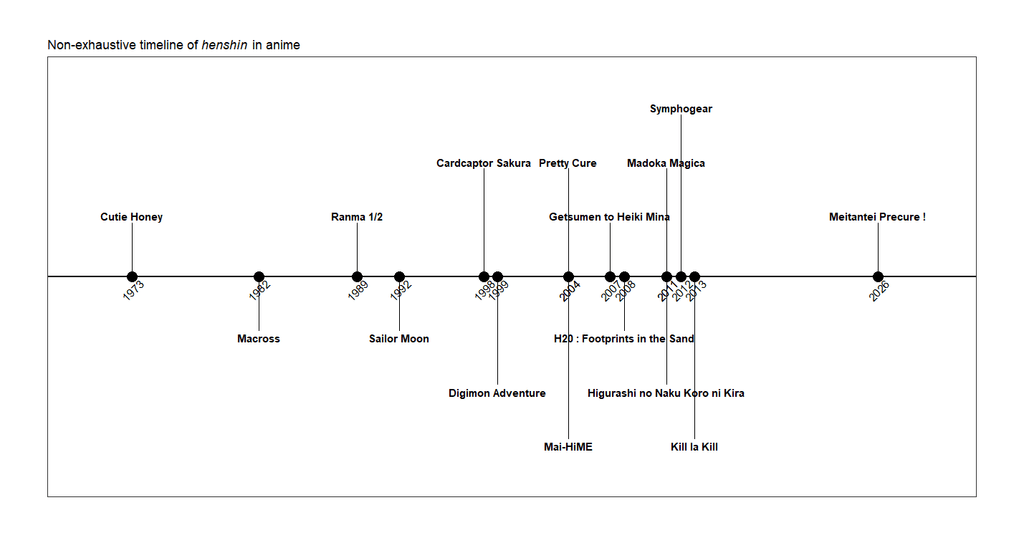
[Figure 3] tells an incomplete story, because to be legible a timeline requires to select a few representative points in time. In truth many more series use henshin as a device, but at least it informs us as to how pervasive henshin has gotten throughout the years, perhaps being one of the most recognizable aesthetic elements of the particularity of Japanese animation, or of what characterizes anime as a repertory.
After [Figures 1, 2 and 3], we are equipped enough in occurrences in media to get more abstract and give a model of henshin, which we will then be able to question through a comparative critique of Yuri Kuma Arashi and Puella Magi Madoka Magica with the angles of gendered queerness, phenomenology and liminality.
Henshin ( 変 身 ) means “transformation” or “metamorphosis”. This is the chosen name for translating Kafka’s The Metamorphosis in Japanese. However, contrasting from this literary device, in anime henshin is not something monstruous like a cockroach (or perhaps in the case of Clevatess it is), but attractive, even sexualized at times (13 out of 40 entries in [Figure 2]). It is a time of narrative non-linearity, as the character seems to be in another metaphysical plane, where time occurs differently. During the suspension of narrative time, animation itself is different, with the use of rhythms to characterize exuberance, as if transformation is somewhat pleasurable, or freeing, or an outburst of energy. Nudity is not policed by society, but instead acquires a symbolic, perhaps even cosmic nature. Gendered elements can appear to queer the body, out of thin air as it were, or enforce stereotypical feminity, even sexualized. It is a time, perhaps, of temporary maturation, as the character seems to gain a boost, bolstering their strength and agency. But it can also be tragic, like in Madoka Magica or in the Mai-HiME franchise. And it has marked Japanese animation since at least the 1970s to still be an aesthetic landmark of anime [Figure 3].
IV. Queer transformations in Yuri Kuma Arashi and Puella Magi Madoka Magica
- A) Gendered queerness in henshin
The first angle we will compare both series through is gendered queerness. This only makes sense if we understand contemporary Japanese society, and its imaginary depictions in anime, as marked by binarism. It is not that subversions to this established orders aren’t acknowledged, rather they are depicted to further police the structure of gender power dynamics. The association of feminine characters to sexualization is why it is statistically rarer to see male characters depicted sexually, even in the only context of henshin scenes. When masculine characters are depicted through suggestive framing or sexualized, it seems that they are also associated with elements of androgyny [7, Figure 2]. In episode 8 of H2O: Footprints in the Sand, a masculine-bodied character, claiming to be a mother, but with a beard and visibly hairy but shaved legs — reminiscent of the way trans characters are depicted in One Piece‘s Momoiro Island arc [20], is used as comedy relief with transmisogyny [9], while other characters manifesting the social identity of feminity, by virtue of being cis, aren’t assigned the same status of comedy relief, even heightened to the quality of mahou shoujo, therefore having more exposure in terms of time and cuts, and agency and importance to the plot of the episode.
“The basic argument I made in Whipping Girl [2007] goes something like this: What feminists have long called “sexism” actually consists of two forces. There’s “traditional sexism,” which is the notion that femaleness and femininity are inferior to, or less legitimate than, maleness and masculinity. But in order to maintain that hierarchy, there also needs to be a way to discourage people from blurring or traversing these distinctions. I called that force “oppositional sexism” and defined it as “the belief that female and male are rigid, mutually exclusive categories, each possessing a unique and non-overlapping set of attributes, aptitudes, abilities, and desires.” In other words, transphobia (as well as homophobia) stem from oppositional sexism.” [9]
The contexts of Yuri Kuma Arashi and Puella Magi Madoka Magica lend themselves to a study of queerness because of homoeroticism as a common denominator. Although, in the context of Yuri Kuma Arashi it is perhaps more self-evident than in the latter, Puella Magi Madoka Magica. Just taking AniList’s synopsis for Yuri Kuma Arashi, we can read that:
“At some point, somewhere in outer space, the small planet Kumalia exploded. As the particles of what used to be Kumalia showered upon Earth as a meteor shower, for some reason all the bears on earth stood up to attack humanity! In due time, a great “Wall of Extinction” was built between humans and bears, and they could no longer show aggression towards one another… One morning, Kureha Tsubasa and Sumika Izumino were alone watching lily flowers blooming. Just then, a Bear Warning pierces loudly through the air! Mystery brings on more mysteries, a series of one raging blow after another!” [10]
We can compare the “aggression towards one another” [10], with homosexuality. The “Wall of Extinction” [10] is a plot device for homophobia, as it structures society in the narrative. With such a logical premise, the infiltration of homosexual women in a school is a subversion that finds its historical inspiration in the tradition of Class S [11]. We also learn that Kureha and Sumika are lovers, which is made clear as day with “alone watching lily flowers blooming” [10], which makes more sense when one considers that yuri (百合) means “lily”.
“In the 1920s in Japan, girls attending single-sex secondary schools developed a girls’ culture (shōjo bunka) or subculture to insulate themselves temporarily from the pressures of patriarchal society. Part of this subculture was a practice called s kankei (s or sister relationships), also called Class S, which were same-sex romantic attachments between classmates, condoned at the time as a temporary practice relationship that would end upon graduation, followed by an arranged marriage. Although s relationships were not ‘lesbian’ in the contemporary sense, literature and film created by men in the 1920s through the 1960s appropriated aspects of girls’ culture, including exploitative representation of female homosexuality.” [11]
But as for Puella Magi Madoka Magica, there are many releases with Magia Record as a spin-off. We are to concerned only with the first installment of the series, where Madoka and Homura develop a relationship that is fateful. This, and the spiritual continuation found in the third movie, Rebellion. We can only qualify the subtext as homoeroticism, because it is never told that there is love. Walpurgisnacht: Rising is not a movie I have had the opportunity to watch, so I can’t quite judge the subtext in the ways it changes it. But the key visual shows that Akuma Homura is a part of the narrative [12].
Madoka Magica is seen as one of the top representations of queerness as coined by fans, focusing specifically on Madoka and Homura’s relationship. […] [They] become seemingly romantically intertwined, which can be seen through the efforts Homura makes when attempting to break the traumatic cycle the girls are stuck in. […] By some folk’s belief, this is a romantic, valiant effort made by Homura as it was [her wish] to be able to save the one she loves (Madoka). [… /] However, there seems to be a potential issue that arises within the queerness in Madoka Magica, stemming from an interview with author Gen Urobuchi gave in 2013 at AnimagiC in Germany. […] Urobuchi [was asked] if Homura is in love with Madoka, [and he replied] “probably”. […] When another question is asked about why Urobuchi chose to portray “homosexual love”, he responds with “[I] don’t think it is that special – a really strong friendship turns into a [love-like relationship] without the sexual attraction, in their case”.” [13]
But then, we need to define what is meant by homoeroticism. It is when there is a potential for intimacy, whether platonic, sexual or romantic — although the presence of eroticism as a term does invite a more mature reading — between characters of a same gender or sexual identity, that seems to go beyond traditional friendship, or what is considered as normalcy for two characters of a same gender, especially in a narrative that is depicting compulsory cisheterosexual norms. One needs to remember, for Madoka Magica, the recipient of Sayaka‘s wish being an apparently cis boy, also the object of a crush by Hitomi Shizuki. This love triangle premise, and the assumption of compulsory heterosexuality by both Madoka’s mother and her teacher, are all confirming this: straightness is expected, if not platformed at the forefront of the show as opposed to homoeroticism. As such it is of course going to be arbitrary. Still, we have words from the scenarist himself [13] that there is a romantic subtext in Puella Magi Madoka Magica and the Rebellion movie.
But if fans’ consensus appears a valid source of knowledge with regards to anime criticism, if only because they participate in the fluidity of Japanese popular culture representations through doujinshi and circles, then there is a contribution to the Anime Feminist blog [14] that finds Yuri Kuma Arashi relatable in its depictions of lesbophobia to the experience of transmisogyny, specifically in being out of the closet and in engaging in a subversive transition, and facing systemic oppression.
“Two bears are presented with a choice: will you be invisible, or will you eat humans? They look like teddy bears, and they are on trial. Two girl bears–two lesbian girls–Ginko and Lily, standing before three male judges deciding whether or not they should have the right to exist. In order to have their love approved, they declare: they will eat humans. They transform, taking on human form as they don hypersexualized bear girl outfits, and they enter the world of the school.” [14]
It is significant that it is male characters that possess the right to judge the trial. The “hypersexualized bear girl outfits” [14] thus stand as a extreme subversion, giving henshin scenes queer poetic potential. But can we say the same of Puella Magi Madoka Magica? Are transformation scenes particularly sexualized? Not to mention that in both series the characters undergoing henshin are minors, which further dramatizes the matter by becoming problematic. In fact, there is a gradual queerness in Homura Akemi’s character development.

belongs to respective owners.
In [Figure 4], the fate of rebirths that characterizes Homura’s growth as a deuteragonist is
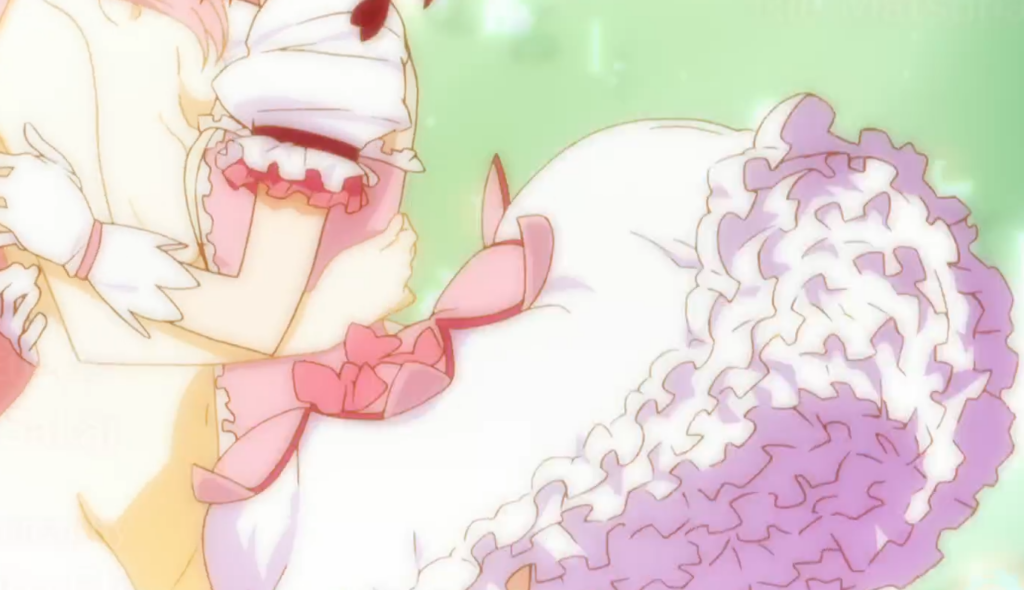
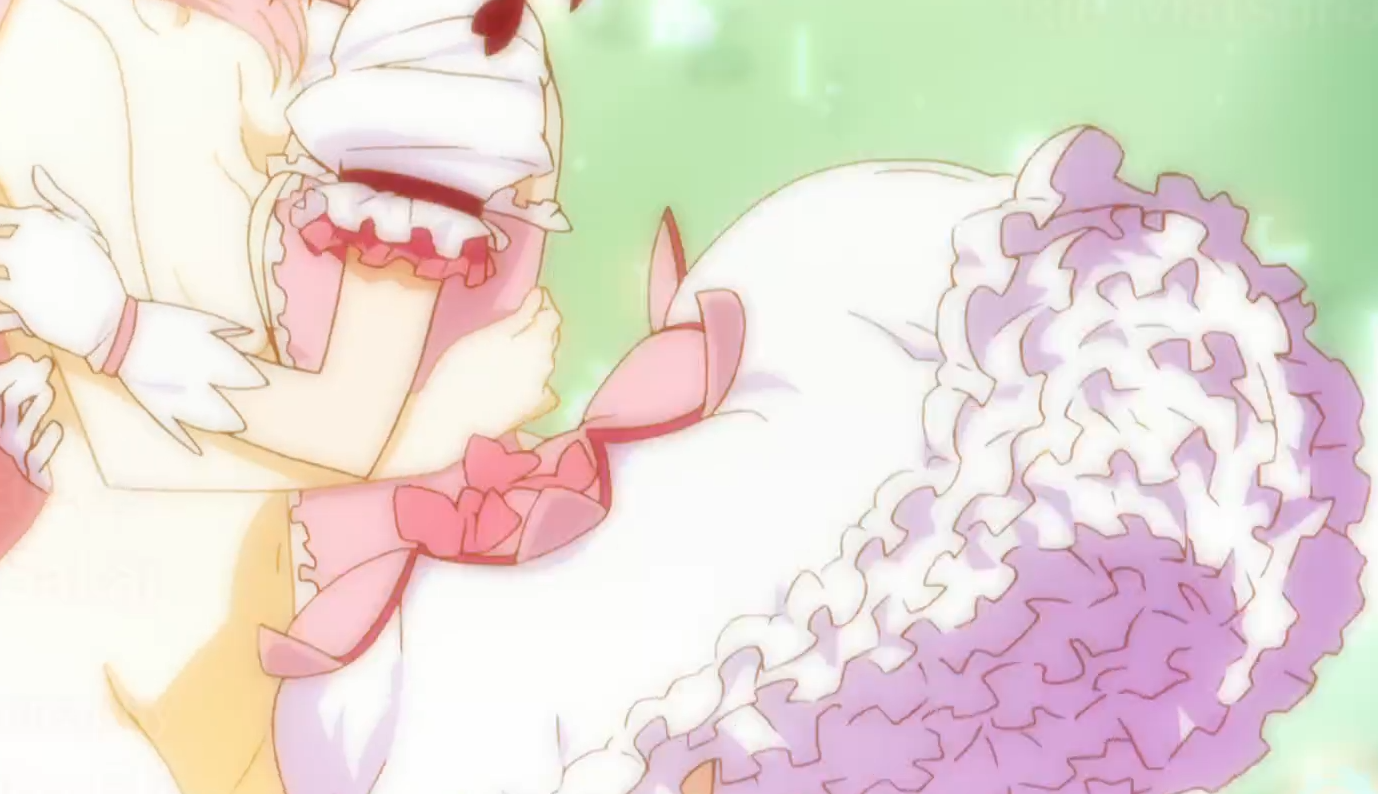
beginning, as she is removing some hair accessory that was binding her hair in a meek fashion. In a way the scene acts as henshin scenes do, by marking a threshold moment, except the presence of the background indicates we are still in a normal temporality and existential plane, as opposed to transformation scenes, or mazes which have been read as queer before by scholar Kevin Cooley [15]. Hair and fabric undergoing motion is common in henshin [Figure 1].
“”Madoka’s ultimate action [can be read] as not abolishing the creative reparative work of the labyrinth, but as positioning herself as a new kind of “incubator.” Madoka cultivates the right environment so that these witches might hatch across time and space, from the eggs of their labyrinths, and take on a pronounced level of queer embodiment free from Kyubey’s machinations that overlap with the aims of compulsory heterosexuality for the service of an endless market economy. The inherent and inexhaustible seriality of Madoka is what makes this reading possible. Seriality itself [for instance in historical displacement] with the anime’s reclaiming of Joan of Arc and Cleopatra as magical girls […] is a key component in what allows these labyrinths to position the magical girl as queer.” [15]”
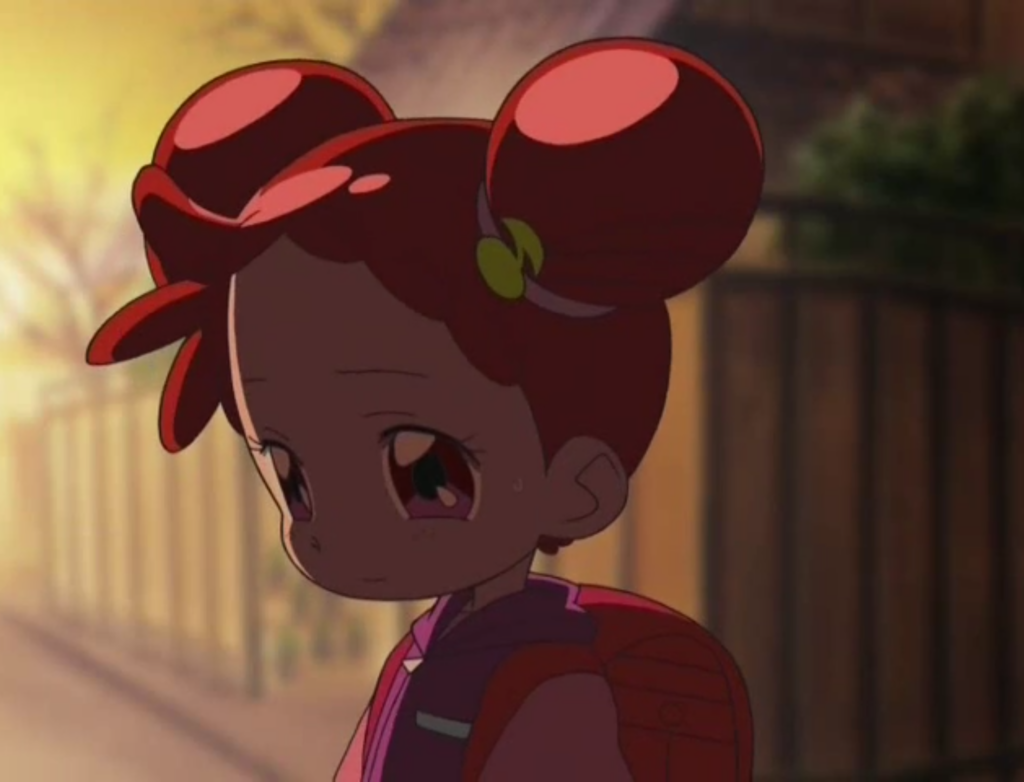
Going back to [Figure 4], removing her hair accessory is a matter of resolve, but also of fatefulness, a reading we can defend informed by the red hair ribbons given to Homura by Madoka herself in the narrative, like a red string of fate. This is the first transition, when Homura goes from meek to more bold. Homura’s hair is significant in the plot as she often blows it in front of people, irreverently. This is perhaps more of an in-your-face feminity, and the final grade of this evolution is finally in henshin, specifically in her Rebellion form. She is also called Akuma (or Devil) Homura, after the Law of Cycles [16].
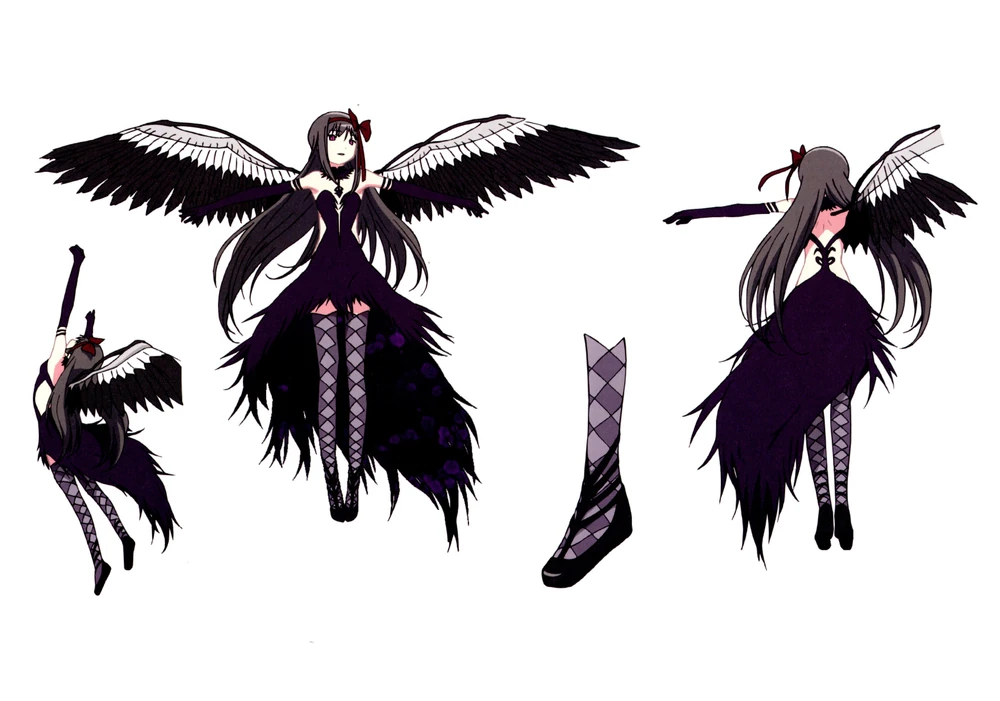
owners.
In [Figure 5] we see Madoka’s red hair ribbons as an element informing us of the narrative chronology. The black stockings of Homura’s character design, either as mahou shoujo or in school uniform, depict her as demure, if a little mature. But the demure part is gone in Akuma Homura, and the same can be said of her visible armpits, back and torso. This can be interpreted as sexualized, and is also a form of her engaging more deeply in the homoerotic subtext. Henshin is the connecting thread. The black wings are also a narrative element [17], characterizing Homura like a raven or a crow, which can be interpreted as a symbol of ruin as they can act as scavengers, but also as smart. The rhythms in her transformation sequence — which are probably examples of framerate modulation [1] — are delightfully packed with meaning, as the wings beat with an impact frame that flashes to white, and she is shown previously as freed after curling in a fetal position. The black shoes also characterize her as more mature. [Figure 5]
Even if in both Yuri Kuma Arashi and Puella Magi Madoka Magica, henshin is used to depict cisgender characters, they are queer by virtue of homoeroticism subtext, against a norm that is structural to cisheteronormative society. And they can also be vessels for fans’ interpretations, that can carry genderqueered projections [13, 14, 15]. To further complexify our understanding of queerness, we can quote Sara Ahmed, philosopher and author of Queer Phenomenology [18]:
“The queer subject within straight culture hence deviates and is made socially present as a deviant. […] A queer life might be one that fails to make such gestures of return [to “the debt of its life”].” [18]
The debt of life is patriarchal capitalism as criticized in some analyses of Madoka Magica [15], but also the lesbophobia incarnated in the narrative device of the Wall of Extinction in Yuri Kuma Arashi [14].
- B) Phenomenology and liminality of henshin
I must confess to the reader that thinking of animation and phenomenology together has been a long process of maturation. I want to use this study to further concretize my understanding. According to a scholar [19], anachronisms, considered a basic mistake in history — conceived as a discipline whose social function is to produce scientific and as truthful as possible inquiries about objects, that can be arbitrary in essence, ie. queer history —, have been used at least in one occurrence creatively, to consider a system of understanding reality (what we could call the doctrine or system of a philosopher) uprooted, maybe even queered. The philosopher in question is Spinoza, and this anachronism is creative because time has become as important as space to think reality and its phenomena. Since Spinoza thought of reality as determined, the only mastery humans could have over fate would come through awareness, consciousness, science… So thinking of time as essential to phenomena is revolutionary, as it redefines an understanding of agency.
“[Translation mine] It is only during the twentieth century that we started to [consider time seriously in the speculative domain]. Only after Minkowski’s and Einstein’s works in mathematics, and Bergson’s works in metaphysics, would Time be treated no more as a secondary and additional aspect of reality (we could add to this list [Darwin’s] theory of evolution, to which Alexander also refers in his speech).” [19]
This murking of categories is at the core of phenomenology in philosophy, that is, studying consciousness itself. We could say that historically, continental and analytical philosophies diverged epistemologically by adopting different demeanors, phenomenology wanting to target all of consciousness in a pluridisciplinary way, and analysis seeking to define strict objects for focused studies. This apparently spiritual divide is also material, considering the Red Scare accompanying the latter half of the twentieth century in America. This is why there is more political potential in seeking phenomenology and continental philosophies. This pluridisciplary essence is recognized by Sara Ahmed herself:
“Perhaps my preference for such queer turnings is because I don’t have a disciplinary line to follow—I was ‘‘brought up’’ between disciplines and I have never quite felt comfortable in the homes they provide. The lines of disciplines are certainly a form of inheritance. The line, for instance, that is drawn from philosopher to philosopher is often a paternal one: the line begins with the father and is followed by those who ‘‘can’’ take his place. We know, I think, that not just ‘‘any body’’ can receive such an inheritance or can turn what they receive into a possession. Disciplines also have lines in the sense that they have a specific ‘‘take’’ on the world, a way of ordering time and space through the very decisions about what counts as within the discipline. Such lines mark out the edges of disciplinary homes, which also mark out those who are ‘‘out of line.’’” [18]
I see myself in her, because I already cumulate three disciplines with an undergraduate degree in theater studies, and as a student in history and geography. In geography for instance, spatial analysis tends to systematize space and is an approach that may devalue individual experiences of space, while Sara Ahmed talks at some point about queer geographers [18].
Framerate modulation [1 for further reading] is interesting to think of anime phenomenology for both the characters and the viewers, as their very neurological wirings are made to make them put themselves in the characters through a combination of mimesis (how characters imitate plausible anatomies) and mirror neurons (neurons reacting to actions viewed, imagined or even heard in vivid language or through onomatopoeias as if one was doing it themself). Many henshin scenes are characterized by unequal framerates by actions and rhythms [7, 8, 17]. But also by exuberance, which I would define as having energy, excitation, an outburst of growth, pleasure which can be manifested through rhythm.
I argue that this very exuberance is the mark of a feeling of powerfulness in the character itself. And for viewers, this performance becomes part of the spectacular part of henshin. So we access part of the consciousness of the character in a very privileged relationship of intimacy in which even self-care is possible, as demonstrated in [Figure 6]. Hence I think henshin represents the consciousness of the character in some depictions.
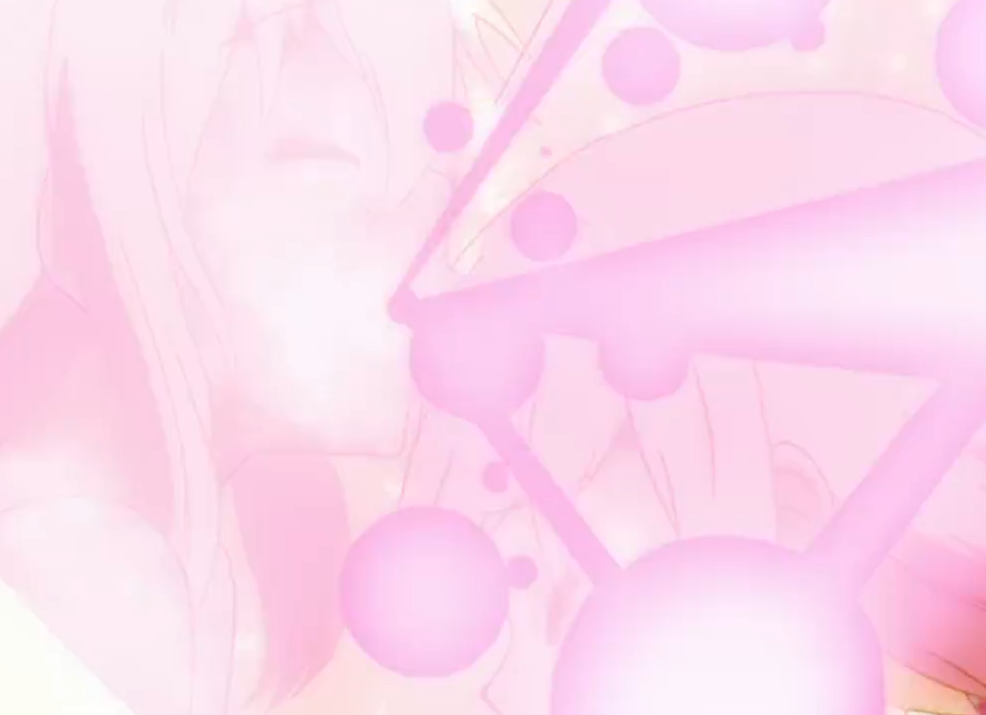
[Figure 6] is interesting because symbolic nudity is used, which we can think means purity, a metaphysical identity, much in the way she breaks the Law of Cycles by demultiplying herself to fight witches eternally and ubiquitously. It is the fate she wills into existence after growing the strength of her wish through a potential endlessness of loops. As such henshin for Madoka is a transition into a kind of unexistence.
Whereas, in the case of Yuri Kuma Arashi, transformation is a way to cross species, a form of transpeciesism, for bear girls to become humans — but in both ways we can think of henshin as transitory and as liminal in the sense of Victor Turner, an anthropologist whose work was initially rather on social rites, but a term whose plasticity has lent itself to so many readings, even architectural and popcultural ones with virtual, liminal spaces. For him, liminality [2] originates from “rites which accompany every change of place, state, social position and age”, quoting Van Gennep.
They also get transformation sequences involving nudity in their respective opening, but they are sexualized, and homoeroticism is much more obvious in this context. What’s more, honey itself as a viscous liquid acts as a cultural reference to eroticism, susciting desire and mentioned in the lyrics.
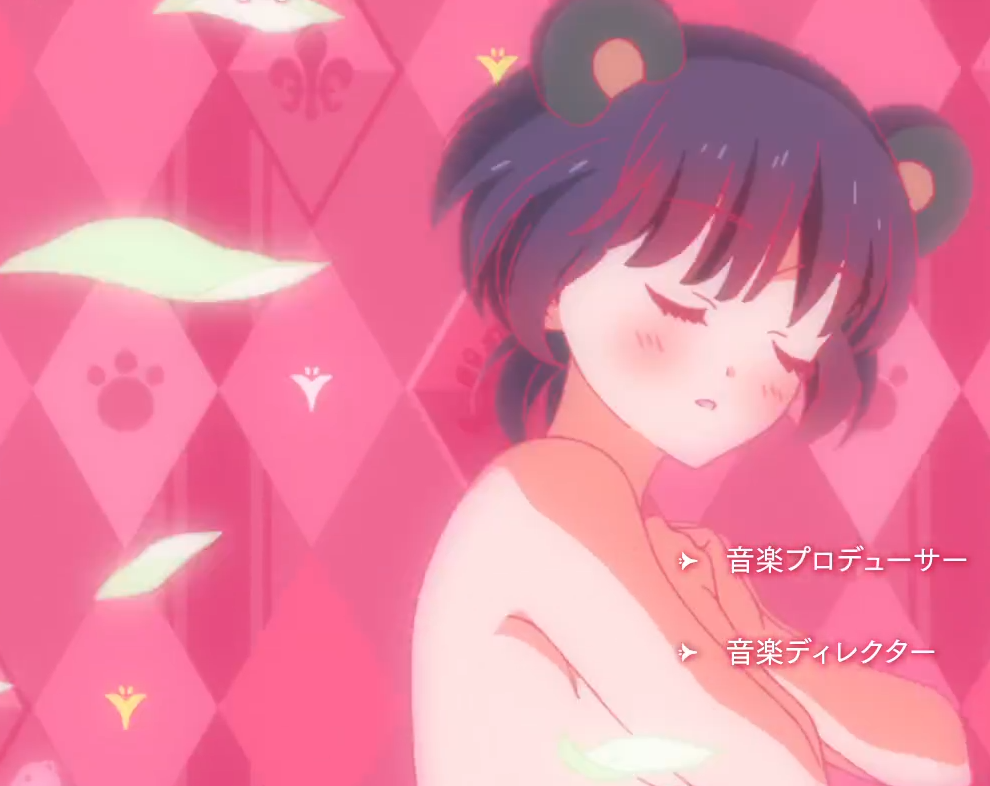
to respective holders.
[Figure 7] shows the bear ears, a part of a character undergoing henshin, crossing the Wall of Extinction. But the ears will be gone soon, so she is in a time of transition, in liminality, identitary and physical. Still, she will keep a teeth that is a common moe element made for viewers, or potentially other characters in the show, to feel attraction and endearment towards her. This is a bodily modification that some people pay dental surgeries for in Japan, called yaeba and apparently “snaggleteeth” in English. The girl is also in a sort of protective stance, kind of like Homura’s fetal position before beating her wings in [17].
This progressive sexualization and queerness can also be thought of as a coming of age, after puberty the discovery of romance and sexuality, (an unproductive, thought of as a “phase” one at that when it is lesbianism) like in Class S [11] tradition and its yuri genre legacy through Maria-sama ga Miteru, Watashi no Yuri wa Oshigoto desu! and even to a degree some Higurashi no Naku Koro ni seasons. There is to find in this a symbolic liminality.
V. Conclusion
It was necessary for us to go through such a thorough analysis of henshin, both as a quantitative and pervasive industry-wide code [Figure 3], and as a way to compare the queerness, nature of consciousness and liminality in two queer-coded works that are Yuri Kuma Arashi and Madoka Magica, to grasp both what is common and what is original in the second part of the article. Because henshin scenes are frequent to see on Sakugabooru [3], one has to understand that they are curated to signify some of what is the most aesthetically pleasing, and therefore significant for the medium to preserve as patrimony. And this, even if the tagging platform seems to depict a sort of market where entries are positionally same in value [4], very much like the otaku is supposed to be wanting to compare as a collectioner in the excerpt of Hiroki Azuma. We have seen through the comparative analysis of the role of transformation scenes in both works that they had to deal with the genderqueerness, as a symbol of freeing oneself from compulsory heterosexuality as a norm [14, 15]. But also that they lent themselves as good spectacular devices for viewers to put themselves in the place of the characters, as well as for characters to explore consciousness as a plasticity, therefore giving henshin scenes a therapeutic and poetic potential. Finally, it is liminality [2] that we explored, as henshin have several thresholds, whether at the level of cuts and framerate modulation [1], or at the level of a scene made up by cuts [17], Sakugabooru also has the storyboard if you’re interested], or narratively for coming of age in Yuri Kuma Arashi and for resolve in the case of Akuma Homura [16]. Of course, because the fourth movie of Madoka Magica is still to come out, some of the things written in this article may become transformed, reinterpreted, and the “seriality” [15] may acquire even more creative meanings.
VI. References
[1] Online article. Matteo Watzky, “Animation and subjectivity : towards a theory of framerate modulation”, Animétudes, May 17, 2020.
[2] Book. Victor Turner, “Liminality and Communitas”, The Ritual Process: Structure and Anti-Structure (Chicago: Aldine Publishing, 1969), pp. 94-113, 125-30, abridged.
[3] Image board. “/henshin | sakugabooru”, Sakugabooru, browsed September 17, 2026.
https://www.sakugabooru.com/post?tags=henshin
[4] Book. Hiroki Azuma, Otaku: Japan’s Database Animals, p. 92, Kodansha Gendai Shinsho, 2001. Translated by Jonathan E. Abel and Shion Kono, University of Minnesota Press, 2009.
[5] Online article. Emilia Lilith-Lolita Hoarfrost, “How Important is Perspective in Anime?”, Medium, February 12, 2024.
https://medium.com/@emiliahoarfrost/how-important-is-perspective-in-anime-c222890e3aa5
[6] Entry. “Episode Direction”, Glossary, Sakuga Blog.
https://blog.sakugabooru.com/glossary/episode-direction/
[7] Image board. “N°315652”, Sakugabooru, browsed September 17, 2026.
https://www.sakugabooru.com/post/show/315652
[8] Image board. “N°110331”, Sakugabooru, browsed September 18, 2026.
https://www.sakugabooru.com/post/show/110331
[9] Online article. Julia Serano, “What is Transmisogyny?”, Medium, May 24, 2021.
https://juliaserano.medium.com/what-is-transmisogyny-4de92002caf6
[10] Entry. Crunchyroll, “Yuri Kuma Arashi”, AniList.
https://anilist.co/anime/20827/Yuri-Kuma-Arashi
[11] Publication. Deborah Shamoon, “Class S: appropriation of ‘lesbian’ subculture in modern Japanese literature and New Wave cinema”, Cultural Studies, 35(1), 27–43, 2021.
https://www.tandfonline.com/doi/abs/10.1080/09502386.2020.1844259
[12] Entry. “Mahou Shoujo Madoka☆Magica: Walpurgis no Kaiten”, AniList.
https://anilist.co/anime/133007/Mahou-Shoujo-MadokaMagica-Walpurgis-no-Kaiten
[13] Publication. Lena C. Humble, “Firing the Canon: Queer Representation in the Magical Girl Genre”, MFA in Illustration & Visual Culture, 44, Spring 2025.
[14] Online article. Tony Sun Prickett, “Becoming Monstrous: Yurikuma Arashi and transmisogyny in the school system”, Anime Feminist, March 15, 2024.
[15] Publication. Kevin Cooley, “A Cycle, Not a Phase: Love Between Magical Girls Amidst the Trauma of Puella Magi Madoka Magica”, University of Minnesota Press 13, no. 1 (2020): 24–39.
https://www.jstor.org/stable/10.5749/mech.13.1.0024
[16] Entry. “Devil Homura”, Madoka Magica wiki, Fandom, 2024-2026.
https://madoka.fandom.com/wiki/Devil_Homura
[17] Image board. “N°86173”, Sakugabooru, browsed September 19, 2026.
https://www.sakugabooru.com/post/show/86173
[18] Book. Sara Ahmed, Queer Phenomenology: Orientations, Objects, Others, Duke University Press, 2006.
https://doi.org/10.1215/9780822388074
[19] Book. Ulysse Gadiou, “L’approche anhistorique d’Alexander dans Spinoza and Time. De l’usage créateur de l’anachronisme en histoire de la philosophie”, Anachronismes créateurs (dir. Alain Montandon, Saulo Neiva), p. 97-111, Presses universitaires Blaise-Pascal, 2018.
https://books.openedition.org/pubp/3913
[20] Online article/proceedings. Emilia Lilith-Lolita Hoarfrost, “Understanding Transmisogyny In Contemporary Japanese Popular Culture: An Anime Comparative Analysis (2024)”, Medium, April 16, 2024.