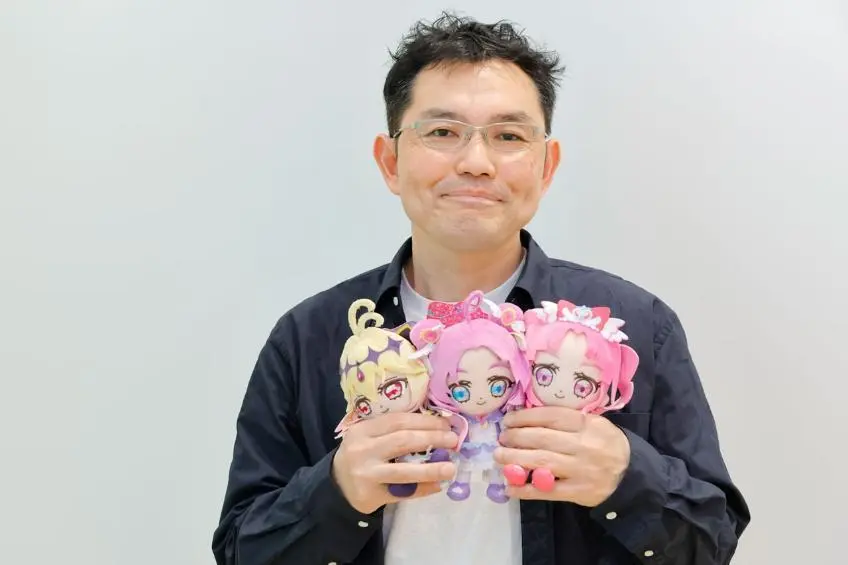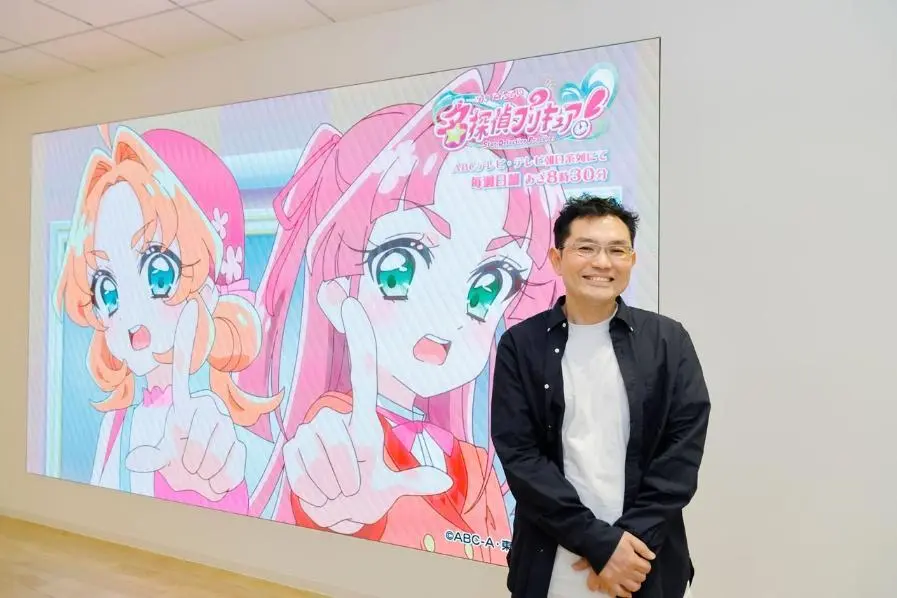
Hello everyone, I’m back again with yet another interview this time it’s our good friend Isao Murayama talking about Star Detective Precure!. He sure loves talking about that lately, it’d be pretty funny if he started talking about other things in these interviews. Like golf, crochet or how he’s secretly a Tranmere Rovers fan.
He is actually, definitely talking about the show he is currently handling Series Composition for. In this one, he’s talking about how he ended up getting the job on this series as well as how he handled the delicate balance between making Star Detective Precure suitable for kids of all ages as well as keeping the adults hooked too. So if you’re here for that, definitely read on and enjoy the interview!
Translation by “nui”, Editing by me. Creating Tricks That Kids Understand and Adults Appreciate – Isao Murayama was originally published on denfaminicogamer.jp in May 2026. Original Link: https://news.denfaminicogamer.jp/interview/260525p
nui Note: I am using Meitantei, Star Detective, Great Detective interchangeably according to how I feel it best suits the narrative but they are essentially all the same thing unless explicitly stated.
You Can’t Write a “Meitantei” Story in the Modern Smartphone Era.
Setting the Stage in 1999: A Reverse Approach
Interviewer: First off, tell us how you ended up joining Star Detective Precure! (Meitantei Precure!).
Murayama: I previously worked on series composition and scripts for Maho Girls Precure!! MIRAI DAYS. The producer for that, Keisuke Naitou, reached out to me and asked, “Our producer Souya Aramaki really wants to ask Isao Murayama to work on Precure, so is it okay if I give him your contact info?” (laughs). At the time, I just thought I’d be writing scripts for a few episodes, but when I opened the lid, it was an offer for series composition!
Interviewer: Was the “meitantei” motif already decided at that point?
Murayama: Yes, it was. When I first heard about it, I thought, “No way, that’s impossible!” (laughs). I mean, we live in an era where security cameras and smartphones are everywhere. Plus, the Precure series needs to keep its stories and expressions simple enough for little kids to understand. I figured doing a detective show under those conditions would be super tough. But then they told me, “First off, the main characters are going to time-slip back to 1999” (laughs). Also, while the main target audience is 3 to 6-year-olds and the sub-target is 7 to 9-year-olds like always, they wanted to make a story that slightly older kids could enjoy too. I already loved detective stories and time travel stuff, so I said let’s definitely do it.
Interviewer: So it was quite a challenging project right from the start.
Murayama: Yeah. There were a lot of other challenging elements to the project too, and honestly, it just sounded really fun.
Interviewer: You mentioned earlier that you thought you’d be writing individual episode scripts but got offered series composition instead. What exactly does a series composition role entail?
Murayama: I think the role changes depending on the project. For example, in an anime with original source material, you decide which chapters become which episodes, or maybe expand on the original work to dig deeper into the characters. On the other hand, for an original work like Star Detective Precure!, the series composer handles basically everything related to the overall story. You play a massive role in deciding core aspects like character settings and themes, what kind of stories go into which episodes, and even where the finale will ultimately land.
Interviewer: So what was your specific scope of work for Star Detective Precure!?
Murayama: At the proposal stage, things like “the main characters time-slip to 1999,” “it’s a meitantei story,” and “there is an enemy Precure whose color is black” were already set. From there, I dug into the themes and solidified the main characters’ goals and the enemy organization’s settings. I would propose a rough draft, and naturally, the series director would have things they wanted to do direction-wise, and the producers would chime in with opinions like, “This kind of development might appeal more to the viewers.” It is basically my job to take everyone’s ideas, incorporate them into the project, and bring it all together.
Interviewer: Were the main characters’ settings still undecided at that point?
Murayama: We knew there would be two main characters, and one of their image colors would be purple. From there, I started making various suggestions. For example, “Let’s have them transform together at the same time for this series,” or “Since it is a detective show, let’s give the protagonist Anna Akechi a clever vibe.”
Interviewer: As the project moved forward, what was the turning point that shaped Star Detective Precure! into what it is today?
Murayama: Like I mentioned earlier, the concept from the start was to broaden the age range of viewers who could enjoy it. Because of that, I actually went ahead and wrote the script for Episode 1 as a hardcore detective story (laughs). Right now, the flow is that they solve the mystery and then get into a battle. But back then, the plot had them solving the mystery while fighting in the middle of the battle. If I do say so myself, it was pretty entertaining (laughs), and the staff loved it too. But when you remember the main target is 3 to 6-year-olds, the content was just a bit too complicated. So we shelved that script for a bit and took a moment to rethink things.
Interviewer: I see. You tried going with the original plan and spotted some issues.
Murayama: Exactly. But if we let the core concept of a detective story slip away here, it would be bad news. So we decided to keep the mysteries at a level that 3 to 6-year-olds could mostly follow, while still making sure the cases were solved logically through real deduction. I feel like things really started moving forward after that.
No Fake Kid Stuff. Creating Tricks That Kids Understand and Adults Appreciate
Interviewer: Looking back at the episodes that have aired so far, you have written a lot of the scripts yourself, but other writers have handled some too. How do you communicate with the other scriptwriters?
Murayama: It varies by project, but for this one, I am pretty much locking in the direction myself. I hand them a fairly long order form that reads almost like a full plot, telling them, “Please write a story like this.” Honestly, finding the right balance to adjust the tricks so kids can understand them is incredibly difficult. So I told them I would handle that part as the series composer. Plus, there are a lot of overarching setups this season that do not resolve in a single episode. Figuring out who Cure Arcana Shadow is or deciding which episode drops what information takes a lot of careful prep work.
Interviewer: You are definitely pulling off some complex stuff in the scripts! How do you build the deduction sequences? Do you start with the incident, or do you start with the culprit?
Murayama: The painting mystery that aired last month (Episode 10, “Solve the Mystery of the Painting!”) was an idea I wanted to do since the very early planning stages. I originally wanted to do a parent-and-child story, something kind of like Oishinbo. Separately, I was trying to come up with a trick involving a painting, and I realized combining the two would work perfectly.
Interviewer: And then you asked Kenta Sata to write the script. So you usually start with the trick?
Murayama: Not necessarily. If it is an episode featuring Cure Arcana Shadow, I might start by figuring out how she should appear, and then build the mystery-solving part around that. Often, it is more like, “This episode already has too much information and viewers’ brains will melt, so let’s skip the hard mystery.” That is kind of how we build it.
Interviewer: Fitting all that into a short 20-ish minute timeslot sounds rough.
Murayama: It is ridiculously hard (laughs). So when I hand off the outline to the scriptwriters, I try to give them an amount of content I think will just barely fit. Even then, it usually ends up being too much. The writers really save me by adjusting things and saying, “Let’s cut this part then.” The Star Detective writing team is truly amazing. If it weren’t for them, I do not know where we would be right now. I owe them big time.
Interviewer: By the way, when you talk about detective stories, there are tons of them in novels and movies, not just anime. What are your favorite detective stories or mysteries?
Murayama: I am a huge fan of Kaoru Kitamura. I have loved his work for a long time, to the point where I will go to any lecture or signing event he holds. A lot of his mysteries deal with “everyday mysteries.” That is why I wanted Star Detective Precure! to focus on everyday mysteries too. Well, it is a kids’ show so we obviously cannot handle murder cases anyway (laughs), so it worked out perfectly.
The Taboo of an “Enemy Precure.” How They Built Her Character So the Audience Wouldn’t Hate Her
Interviewer: Out of your discussions with series director Kouji Kawasaki and producer Souya Aramaki, what stands out the most in your memory?
Murayama: The most fun part of the development phase was definitely Cure Arcana Shadow. Up until now in the Precure series, there has never been a Precure who belonged to the opposing organization and even had her own transformation bank. I wondered if kids would accept such a totally unique Precure and if she would actually get popular. I thought it was a fun challenge, but I knew it would be tough.
Interviewer: We have definitely had characters who started as enemies and later became Precure, but a Precure in this exact position is a first.
Murayama: Because of that, we built her character so she absolutely wouldn’t be hated, like making her “love ice cream” (laughs). We jammed all these ideas together, and then Akane Yano gave her an incredibly cute design. We gave her a huge head start with that design, so it might feel like we overdid it a bit (laughs), but we definitely put a lot of effort into her.
Interviewer: She is super popular now, so that is a relief!
Murayama: We had a chance to show her to everyone for the first time before the broadcast, and I was there at the venue, watching nervously from the corner the whole time. I just kept thinking, “Are the kids going to actually like Cure Arcana Shadow?” (laughs). I am so glad she ended up being popular in the end.
Interviewer: Makes sense. So, what about the main protagonists, Cure Answer (Anna Akechi) and Cure Mystique (Mikuru Kobayashi)?
Murayama: Mikuru tends to overthink things a bit, while Anna is more of a “let’s take a step forward and just go for it” type. However, unlike the usual Precure, we really wanted to show that Anna has her own internal anxieties, which we explored in Episodes 5 and 6. Also, when you think of meitantei stories, there is the classic setup where one is the detective and the other is the assistant.
Interviewer: The classic Holmes and Watson tag team.
Murayama: But for this show, I wanted both of them to be great detectives. Because of that, we never portray one as inferior to the other. Rather than the simple clarity of a buddy (aibou) dynamic, I wanted to show them covering for each other’s weaknesses while proving that together, they are “the” great detective. I decided I wasn’t going to run away from that challenge.
Interviewer: Another thing I have noticed is that the balance between the mystery plotlines and the comedic elements is spot on. Like the interactions with the Phantom Thieves. It is never too serious, but never too goofy either.
Murayama: The core mystery-solving parts are probably the serious or earnest parts of the show. But if we only do that seriously, the story gets stiff. So we sprinkle in comedy elements to soften it up. That is the balance we aim for. As for the Phantom Thieves, they steal things from other people. In that sense, they are committing much more realistic crimes than villains in past Precure series, so they could easily come off as scary people to the kids. That is exactly why we add comedy to them, so they do not get too scary and hopefully look charming instead. Of course, if they lose all their scare factor, the tension disappears, so finding that sweet spot is tricky.
Interviewer: Also, there is Cure Eclair, whose name is listed on the official website.
Murayama: She hasn’t appeared in the main story yet. We have got some really fun and exciting developments prepared, so I hope you look forward to it!
Interviewer: I see (laughs). With things like the reason Anna Akechi time-slipped to 1999, it really is a show where the characters themselves hold a lot of mysteries.
Murayama: That is intentional. Star Detective Precure! has several layers to it. The main target of 3 to 6-year-old kids can enjoy the cuteness and prettiness of the Precure. Slightly older kids in early to middle elementary school can enjoy the mystery-solving. And then the parents watching with them can enjoy the bigger mysteries like, “Why did Anna come to the past?” or “What is Cure Arcana Shadow’s goal?” or “Who is Cure Eclair?” We consciously created points of interest for every generation to enjoy.
“Precure Never Goes Down a Negative Path.” That Restriction Has Kept the Series Fun for Over 20 Years
Interviewer: You have been involved with the series since Futari wa Precure: Splash☆Star. What do you think makes Precure unique compared to other shows?
Murayama: I think it changes depending on the era. For example, Maho Girls Precure! was a series where we didn’t do any of the complex mysteries or foreshadowing that you see in Star Detective Precure!. Leading up to that year, the target age for the series had slowly been creeping up, and we worried that the really little kids might be having a hard time following along. So the policy was to hit the reset button. The concept was to make it episodic, keep the story bright and fun, and return to a show that small kids could purely enjoy.
Interviewer: So it was practically the complete opposite of Star Detective Precure!.
Murayama: Pretty much. That being said, I think “never going down a negative path” is a consistent trait across the entire franchise. In all the Precure shows I have worked on, I have always made sure not to drive the drama forward by making the characters depressed or conflicted. It is very easy to write stories around the protagonist’s inner turmoil and darkness, and adults might eat that up, but I always doubt whether little kids actually enjoy seeing that. I was pretty stubborn about it and refused to go down that path (laughs). Even when a setting is complicated and it would be easier to just explain it, we purposely don’t. We try to keep things as simple as possible for the kids watching and point them toward a bright path. I have always personally valued that while making my Precure series.
Interviewer: As a scriptwriter, what do you find fun or interesting about working on the Precure series?
Murayama: Probably the freedom to build a story since it is an original work. There is a certain framework, of course, but you can slip through the cracks (laughs) and try lots of different things. Maho Girls Precure! is a great example, with its complex magical culture settings, or having the main characters become adults in the final episode. We get to challenge ourselves with stuff like that. Or with Star Twinkle Precure, the Precure end up fighting the very source of the universe, basically a god-like entity (laughs). You do not really get to do things like that in other shows, and it is a lot of fun.
Interviewer: Yeah, I guess that’s true (laughs).
Murayama: So I always end up making the final boss the chaos of the cosmos or the god who created the universe (laughs). How much freedom you have probably depends on the team structure for that specific show, but I have been lucky enough to be allowed a lot of creative freedom.
Interviewer: This article will probably come out right around the time the first cours wraps up. Which episode so far gave you the biggest sense of accomplishment while writing it?
Murayama: I put a massive amount of spirit into writing Episode 1. I mentioned earlier that I wanted a double transformation, but doing a double transformation is actually super hard. It is not just about them transforming; you have to set up individual motivations for both of them to transform. On top of that, we had the deduction part, and we needed to show them time-slipping to 1999. There were just so many things we had to pack in.
Interviewer: It definitely felt like an Episode 1 with insane information density!
Murayama: We made it while constantly talking as a team about how to fit all that into the broadcast runtime while still making it an emotional story, so it means a lot to me. When I saw the first preview screening of Episode 1, I was genuinely moved. Episodes 5 and 6 also really stand out to me. Having Anna openly express her true feelings helped her character really connect with the audience. Usually, we try to avoid episodes where the main characters argue, but this time Kouji Kawasaki, Souya Aramaki, and the rest of the producers gave us the green light. I am really grateful they let me write those episodes.
Interviewer: Jett-senpai was also really memorable for smoothing things over between Anna and Mikuru.
Murayama: Yeah. That was the moment the three of them really became a single team. The theme was “after the rain, the ground hardens” (what doesn’t kill you makes you stronger), and I wrote it with the idea that this is where the CUREtto Detective Agency truly begins.
Interviewer: Another feature of Star Detective Precure! is how townsfolk from past episodes keep showing up again.
Murayama: That is for world-building, or creating the atmosphere of the town. Having the same characters show up repeatedly gives off the vibe that they actually live there, which builds the atmosphere. That is one reason. Also, since it is a detective show, if you have three suspects, you have to design three new characters. If we bring back familiar faces, we can lessen the workload for the animation staff, which is a nice production bonus (laughs). But I am sure the viewers enjoy it too. They get to go, “Oh, the person involved in that old case is doing this now!” We have plenty more of that coming up, so I hope people look forward to it.
Interviewer: Finally, please tell us what to look out for as Star Detective Precure! Continues!
Murayama: Going forward, you will find out exactly what kind of character Cure Arcana Shadow is and what she is after. Also, as the CUREtto Detective Agency keeps solving cases involving the Phantom Thieves, they are going to slowly get famous. As that happens, the types of clients and cases they get will change. There are a ton of new developments waiting, so please stick with us and enjoy it to the very end!