Hello everyone, a bit of a different interview on the site today. Instead of the magic of…magic, we’ve got the magic of electricity with a translation of the first staff interview from the latest Kyoto Animation anime, Sparks of Tomorrow (Denmoku)!
Made a special effort to attend the world premiere of the first two episodes at MCM London Expo, also meeting up with some awesome friends along the way. I was incredibly impressed with the show. It looked incredible and had plenty of silly and fun faces which you can never have too much of. I know all of you will love watching it as much as I did!
So that’s why we’ve got a translation of an interview with Minoru Ota, who also attended the world premiere in London and also Kohei Okamura, who is the Character Designer and Chief Animation Director for the show which was published on the official Japanese website. No idea if it’ll get put on the English website for the show but if they don’t, we might do the rest of the interviews in this series. Please give this a good ol’ read while you enjoy the show!
Translation by “nui”, Editing by me. Chasing an unseen light! Staff Interview Vol.1 was originally published on https://denkimokuroku.jp in July 2026. Original Link: https://denkimokuroku.jp/special/interview/01/
Minoru Ota (Director) x Kohei Okamura (Character Design & Chief Animation Director)
Interviewer: I heard there was an internal competition to decide the character designer. What was the intention behind holding it?
Minoru Ota: We really wanted to deliver a “new Kyoto Animation” with this project. So, we decided to hold a competition to find someone who could draw with a different style and give a completely different impression than what we’ve done before. We honestly didn’t intend to just pick someone who was simply good at drawing, but we ended up with Okamura-kun anyway (laughs). The subject for the competition was designing Kihachi and Inako. Everyone submitted drawings with their own unique flair, but Okamura-kun’s Kihachi just really struck a chord with me. Especially the unexpected “sanpaku gan“.
Kohei Okamura: Was it really that unexpected?
Ota: And yet, it still perfectly captured the core vibe of a protagonist… When you hit the nail on the head like that, even as a veteran, I had no choice but to pick Okamura-kun!
Okamura: Come on, I’m still fresh! (laughs)
Interviewer: Looking back, how do you feel about choosing Okamura-san?
Ota: It goes way beyond just being “glad” we picked him. His technique, design sense… in every way possible, I truly feel this project wouldn’t have happened if it weren’t for Okamura-kun. It feels like he was the only possible choice.
Okamura: I’m really happy to hear you say that.
Ota: How was participating in the competition for you, Okamura-kun?
Okamura: Actually, before this project, there was another competition for the character design of the TV anime CITY THE ANIMATION. I made it to the final selection, but unfortunately, it went to Tamami Tokuyama-san1. I was feeling pretty bummed out about it when I heard they were doing a competition for Sparks of Tomorrow too. But at the time, I was already working on the episode direction for CITY THE ANIMATION and wanted to focus on that, so I wasn’t planning to enter this one.
Then, out of nowhere, producer Satori Senami-san bumped into me at the studio and asked, “Aren’t you going to submit anything, Okamura-san?” I was kind of dodging the question, going “Well…”, and then she said, “Takuya Yamamura-san2 submitted something too.” I was like, “Wait, if Yamamura-san is entering, I have to enter too!” (laughs). From that point on, I decided to give it my all and really went for it. Though, maybe I focused a bit too much of that passion on Kihachi.
Ota: You think so? Well, Kihachi definitely stood out from the rest. I definitely felt that passion.
Okamura: Yeah. The design for Kihachi actually came to me pretty smoothly. Thinking about the director’s requests, the concept art, and Kihachi’s personality in the script, the vibe for the design just popped into my head. Director Ota also said something like, “I want a design that’s so fun the fans will want to cosplay as him,” right?
Ota: I definitely said that. I think the design turned out exactly like something people would want to cosplay.
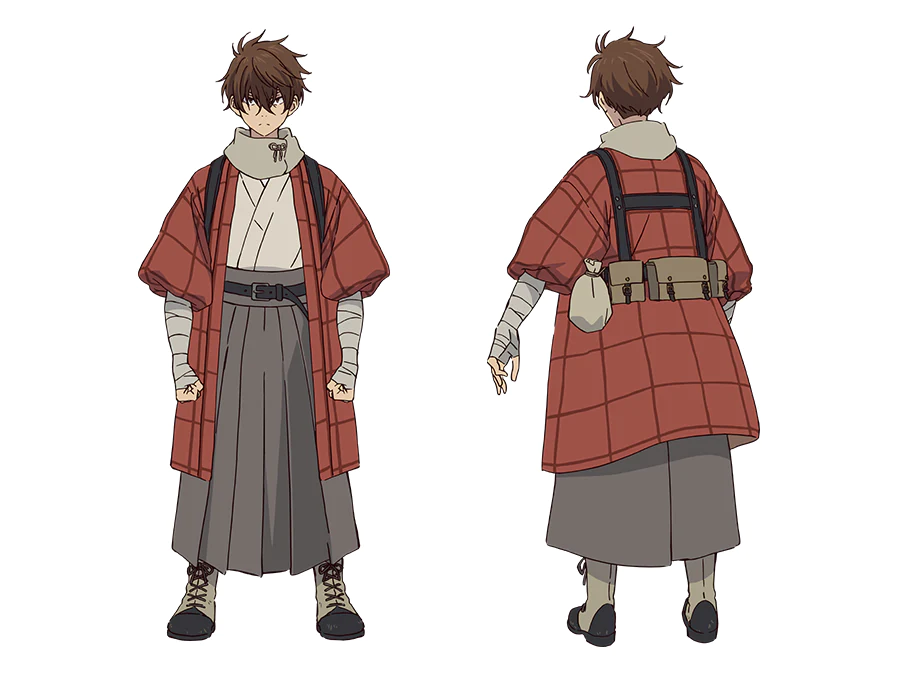
Okamura: Because of that conversation, instead of a normal kimono, I added some tweaks and threw in items that make it instantly recognizable as a character from this show. Like the bandages and the three-piece pouch attached to his back. You know how carpenters have those pouches on their hips and pull out tools without even looking? It’s super cool, right? So I definitely wanted to give that to Kihachi, since he’s a tech guy.
Denmoku Notes:
1 Tamami Tokuyama is the Character Designer and Chief Animation Director of CITY THE ANIMATION.
2 Takuya Yamamura is the Series Director of Tsurune.
Interviewer: Most of the outfits are kimonos, did you struggle with that?
Okamura: It was… nothing but struggles (laughs). Even people who don’t draw can probably imagine, but drawing kimono patterns by hand is incredibly tough. We even tossed around the idea of just using texture overlays, but our manly Director Ota was like, “No, no, we have to animate it by hand.” That one comment sealed the deal for hand-drawn animation. We thought about different patterns, but half-baked patterns just reveal the production side’s shortcuts, you know? Like, “Oh, they skipped the patterns to save animation energy.” But since this is Kyoto Animation’s first new project in a while, we really had to put our all into it. Director Ota and I made the call to go all out, fully knowing we’d get all sorts of opinions from the key animators, in-betweeners, and other departments.
For the character design work on this project, we introduced digital drawing. Usually, the workflow is drawing the line art first and then having it colored, but kimonos are all about the colors. So for this project, we drew the reference sheets with colors from the very beginning and then dropped that impression into the line art. That’s a unique point of dedication for the kimonos this time around.
Ota: I was always watching, feeling bad for making Okamura-kun do all the coloring too.
Okamura: Really?
Ota: Yeah. You just talked about “closing your eyes to the animation energy constraints when thinking about the kimono patterns,” but honestly, I was secretly thrilled watching you propose that. Whenever I couldn’t make up my mind, Okamura-kun would pitch it to everyone, and then I’d just steer it like, “Well, if Okamura-kun says so, let’s do it” (laughs).
Okamura: (laughs). Yeah, I feel like whenever the director started stressing over something, I’d step in and say, “Let’s go with this,” or “We can get yelled at together later” (laughs). But it wasn’t just me; a lot of the main staff on this project were like that. The type to crank up the difficulty themselves.
Ota: Very true.
Okamura: Like color designer Fuyuki Otsuka-san, or art director Mao Takayama-san. Everyone kept raising the bar on their own, always trying to propose something one step beyond the quality Director Ota was probably hoping for. It was such a fun, great team.
Ota: Everyone was so proactive, constantly throwing out ideas, which was a huge help. People often talk about my personal touch regarding this project, but it actually contains a ton of input from everyone else too. I think that’s why it became a work with such a strong sense of variety.
Interviewer: How does Director Ota see character designer Kohei Okamura?
Ota: I think he’s someone who, while understanding my intentions to some extent, went above and beyond me when it came to the characters. I gave the orders, but every single character turned out beyond my imagination. I truly believe “this is how character design should be,” and I think Okamura-kun is someone who can pull that off.
Okamura: At first, I had no clue what Director Ota liked. So, through lots of communication, I did some “Director Ota Research” based on his words, actions, and hobbies (laughs). After a while, I started to understand what the director wanted to do.
Ota: Lately, you even act as my interpreter sometimes.
Okamura: The other staff members even get creeped out like, “How do you understand him?” (laughs).
Interviewer: Conversely, how does Okamura-san see Director Ota?
Okamura: He often says himself that he’s “easily swayed by others’ opinions,” but that’s not true at all. Director Ota is a very stubborn person. People around him think he’s someone who absolutely refuses to change his mind.
Ota: Really? Am I stubborn?
Okamura: You are stubborn! But it’s being “stubborn for the sake of the project,” not “stubborn for yourself,” so I think it’s perfectly fine. Around the time we started production, Director Ota told us, “Let’s all go through a fun hell together.” I thought it was a great quote. And we definitely got to see hell.
Ota: It was a very beautiful view.
Interviewer: There are probably people reading this who want to become creators after watching this show. Do you two have any messages for them?
Okamura: This isn’t just limited to drawing, but you should experience as many different things as possible. Even for character design, if you haven’t interacted with various cultures, you might not be able to draw them, or even if you use references, it might lack a sense of reality. Like the story about Kihachi’s three-piece pouch earlier. Seeing a cool gesture and wanting to have a character do it really pays off. All that information and those experiences eventually connect to the act of drawing. So go travel, or try out different jobs. There’s no doubt those experiences will be useful somewhere down the line. Improving your drawing skills is important, but above all else, experiencing a wide variety of things is the most crucial part, I think. Also, communication skills. That’s super important too.
Ota: I agree. Don’t just stick to what you like; actively look at things you have no interest in or even things you think you dislike. It’s okay to dislike them, but it’s great to build the habit and effort of trying to understand them. I really felt that during this production. If you only focus on what interests you, the information you take in gets too narrow. I’d love for you to challenge yourself to the point where it feels like a waste of time. Honestly, I had zero interest in stories featuring a lot of boys. But by working on the Free! anime series, I started researching that kind of stuff too. Once I built up that information inside me, I learned how to enjoy it, and actually ended up liking those kinds of stories. Don’t be picky; go out there and experience everything.