Hello everyone, you’re probably thinking “build, what happened to Sparks of Tomorrow Staff Interview vol.4? You missed one!”. You’d think that but that’s actually the long CGWORLD article from a couple of weeks ago! I mean, you could end up finding the “real Staff Interview vol.4”. If so, do pass it on! Until then, we’ll keep pushing on in publishing the translations of the interviews on the website.
This one has legendary KyoAni director Tatsuya Ishihara, who you might know as the Director of Nichijou, Sound! Euphonium and the anime that had a guest appearance in Peppa Pig. He’s joined by Naoko Fujita and Genki Matsumura, long time in-betweeners at KyoAni! Fujita’s been doing in-betweening for over 20 years, so she’s probably the best in the business in the role!
This interview is based around the events that happen in Episode 6 of the show and also some of the challenges of douga (in-betweening) work from the best in the business! If that interests you, keep on reading!
Translation by “nui”, Editing by me. Staff Interview Vol.5 was originally published on https://denkimokuroku.jp in August 2026. Original Link: https://denkimokuroku.jp/special/interview/05/
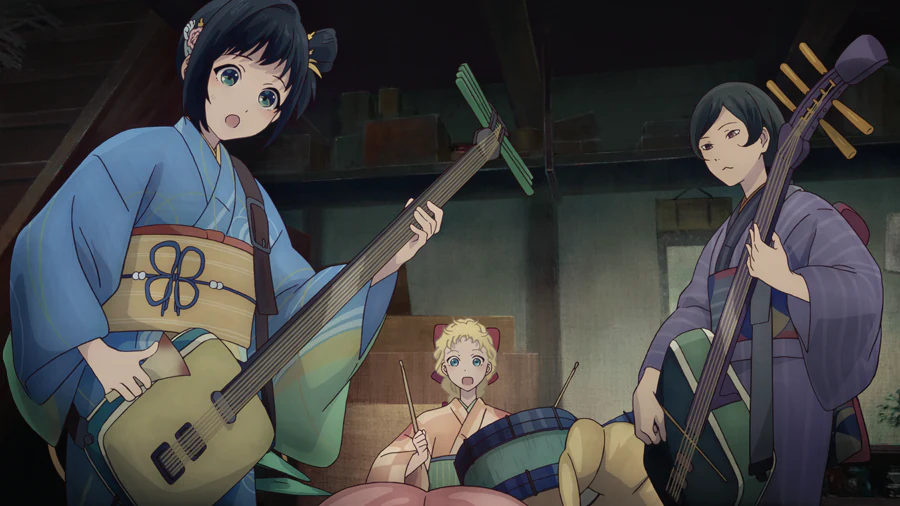
Interviewer: Episode 6 was what you’d call a “band episode,” but what parts were you particular about during production?
Tatsuya Ishihara: To me, it felt more like a “club activities” episode than a band episode. Stories about club activities make it easy to show character growth. For Episode 6, we focused on the relationship between Inako and Jinemon, zooming in on their character development. Of course, Director Oota had his own preferences, so we expressed those as well. He had specific instructions regarding Inako’s emotions during the performance, so we made sure to capture that perfectly. This applies not just to performance scenes but battle scenes too; if the character’s feelings aren’t driving the animation, it’s just not fun to watch. In that sense, I’m really grateful that the director thought about the emotional flow beforehand.
Genki Matsumura: For the performance scene in Episode 6, the in-between animation section took special care with realistic movements, like hair swaying.
Naoko Fujita: We can’t just make them move; we have to make it look like they are actually playing. So in-between work for performance scenes requires way more attention than everyday scenes. In older anime, they would insert flashbacks in the middle of a performance to adjust the workload, but this time they are playing the whole time, so we had to stay focused throughout.
Ishihara: But compared to the Sound! Euphonium series, it was way easier, right?
Fujita: That’s true! (laughs)
Matsumura: The sheer number of instruments is different, but wind instruments and guitar-type instruments are completely different too. Wind instruments have a lot of complex finger movements, like pressing here and releasing there.
Fujita: Exactly. Guitar movements are relatively monotonous. We still had a lot of fine movements this time, but I just told myself, “Compared to Eupho…” and did my best (laughs).
Matsumura: But this time we had original instruments, which brought a different kind of difficulty. We were struggling with the animation while constantly comparing the key animation with the design settings for the mics and drums.
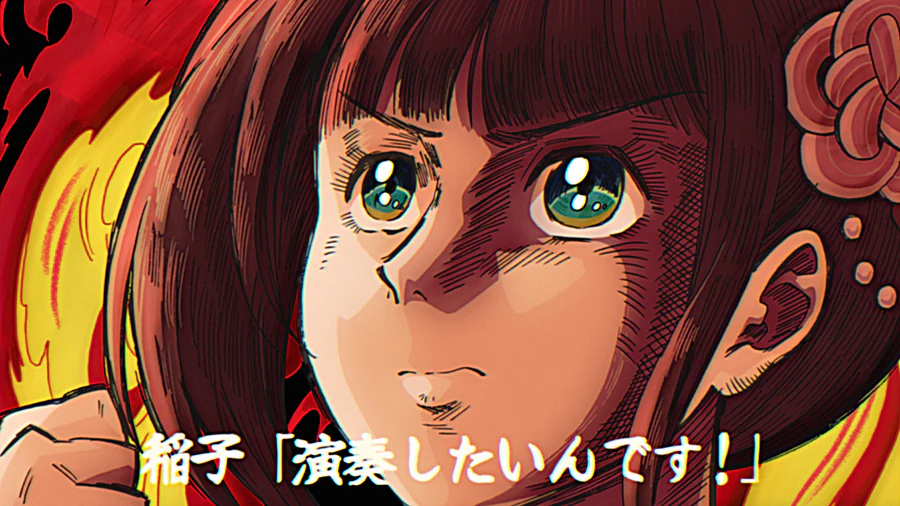
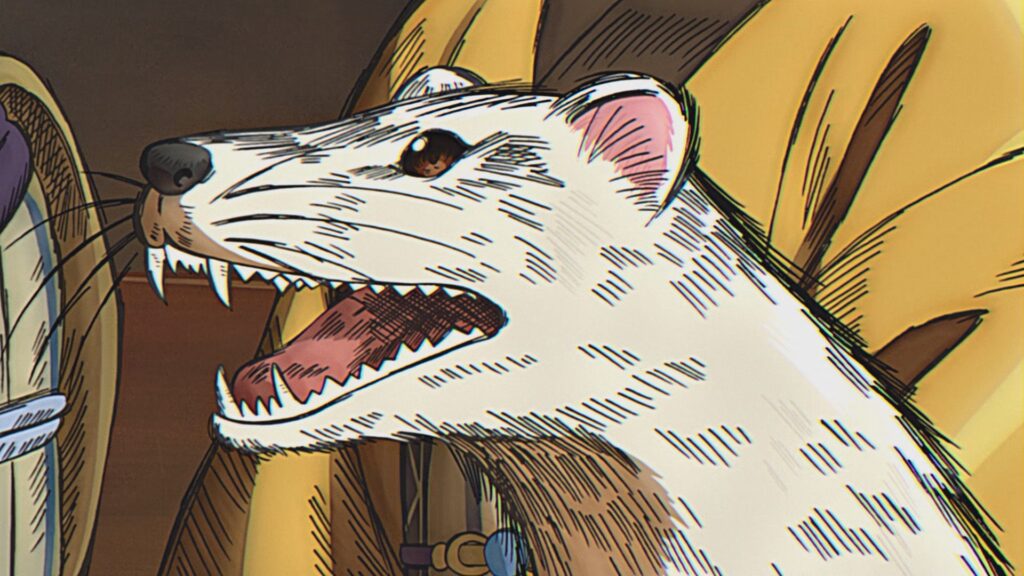
Interviewer: The gekiga-style scenes in this episode were also striking.
nui note: Gekiga (劇画) means “dramatic pictures” and is a style of Japanese comics created specifically for mature audiences. It emerged in the late 1950s as a darker, more realistic, and serious alternative to mainstream manga, which was primarily aimed at children at the time. When the animation staff in the interview discussed creating a “gekiga-style scene,” they were referring to mimicking this specific vintage aesthetic.
Ishihara: We decided early on to go with a gekiga style. Before we started production, we talked about how scratchy the lines should be, right?
Fujita: Yes. I think it started when I asked, “What kind of visual feel are you aiming for?” It’s hard to recreate that analog roughness where you intentionally show gaps between lines. So I wanted to confirm the direction you were going for.
Ishihara: In modern anime production, we pour in colors using digital tools on a PC like the bucket tool, so the lines have to be drawn solidly without breaks. So there was the issue of whether it would be okay to have scratchy lines like this.
Fujita: Taking that into account, the paint section and art background section got together, and we decided on the direction while discussing it.
Matsumura: Speaking of colors, we intentionally limited the color palette for this scene. When I heard about that, I was surprised and thought, “That makes sense!”
Ishihara: You can create infinite colors on a PC now, but during the cel animation era, we only had a few hundred colors available. I don’t think that was a bad thing, though. It’s just my preference, but I think there’s a beauty that comes from limitation. So I asked if we could create it within that limited color range this time too.
Fujita: You used to do cel painting back in the day too, right?
Ishihara: Yep. Kyoto Animation started as a finishing and paint company that painted cels, so back when it was founded and I was young, I painted cels too.
Fujita: I definitely felt that this style was only possible because you experienced the cel animation era.
build note: Ishihara’s been at KyoAni since 1988 with one of his earliest credits on Oishinbo as an Inbetweener himself. Although KyoAni weren’t producing their own TV anime for a fair few years after that, they were a subcontractor on various shows in the 80s and 90s.
Interviewer: I heard that many young in-between staff worked on these scenes.
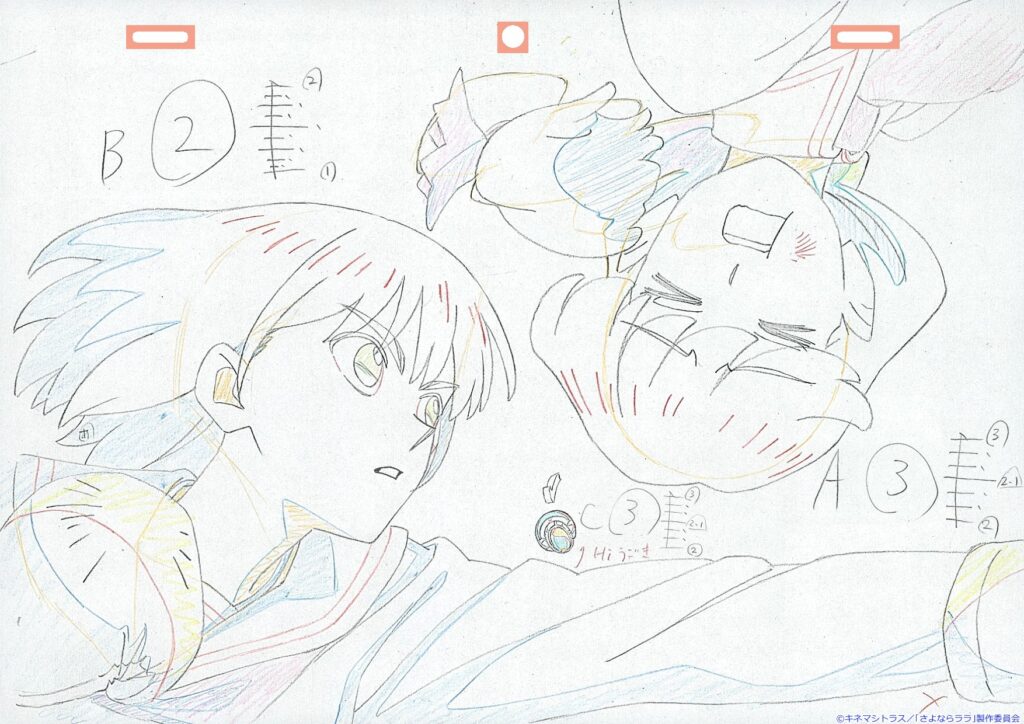
Fujita: To begin with, my generation is the very last to have experienced this kind of technique, and younger generations like Matsumura-kun have never done it. I wanted the younger staff to experience drawing in that style to add to their skill set. I gave them some general instructions on line thickness, but I think everyone thought it through and drew their own ideal gekiga style. We also used pen animation instead of the pencil work used for CITY THE ANIMATION. By encountering and thinking about these various techniques, I think their skills will naturally improve.
Ishihara: Speaking of which, I decided we could pull off the gekiga-style scene precisely because we had the experience of doing thick line animation on CITY THE ANIMATION.
Fujita: So that’s why! (laughs)
Matsumura: Just like the experience on CITY THE ANIMATION led to this project, I think this show will also build up our knowledge, and we can say “We can use these methods too.” Even if it’s not gekiga style, it expands our options for the future.
Interviewer: Looking at the whole series, what was difficult for the in-between animation?
Matsumura: Probably the kimonos. The swaying of kimonos is often left to the in-between section. I sometimes secretly changed things from the key animation just to make the patterns match (laughs).
Fujita: I did that too! (laughs) For kimonos, the Otaiko style obi knot was really tough. Sometimes it was drawn wrong in the key animation, and there were a lot of retakes even after it was finished. More than anything, the patterns just wouldn’t line up.
nui note: Otaiko-musubi (お太鼓結び), or the Otaiko style, is the most standard and widely recognized method for tying a woman’s obi (the wide sash worn with a kimono).
Matsumura: Yeah. From the perspective of an in-between checker, reading the patterns on the submitted in-between frames was a nightmare. We often got notes from the paint section asking, “What is going on with this pattern?” It was only after they colored it that we realized the pattern was misaligned.
Fujita: The checkerboard pattern was hard too. Then they added camellia patterns on top of it, so sometimes we’d paint it and realize a camellia was missing where it should be. In the end, we just had to make it work.
Ishihara: Did this show have a lot of character parts to begin with?
Matsumura: Yeah. Especially Inako, who has hair ornaments on both sides, so no matter which way she turns, there are a lot of parts to draw (laughs).
Interviewer: There might be people aiming to be creators after watching this show. If they want to become an episode director, what kind of studying or mindset do they need?
Ishihara: I don’t know about aptitude (laughs). But whether it’s a commercial or an artistic work, I think a spirit of “service” to the viewers is necessary. As for studying, I think it’s good to watch documentaries. You gain knowledge, but you also learn to understand people’s feelings more deeply. These days you can watch your favorite media whenever you want, but it’s better to expose yourself to various things to broaden your perspective. In that sense, documentaries are a great chance to learn about people from different professions and circumstances. To sum it up simply, “Take an interest in other people.”
Interviewer: What do you think is required for being an “in-betweener” or “in-between checker”?
Matsumura: What’s needed is to take an interest in movement and keep exploring it. There’s no special way to study, just be interested in movement and actually try drawing it. I think it’s important to increase your own arsenal that way.
Ishihara: You also need the mental stamina to endure meticulous work.
Matsumura: True. The mental fortitude to draw the same picture over and over is a crucial trait. And if you want to be an in-between checker, you need to be able to grasp the image of the movement at the same level as the key animators. As the final gatekeepers of the animation process, you need that level of resolve.
Fujita: You have to comprehensively check if it’s moving properly before it goes out into the world. That requires the inquisitive mind Matsumura-kun mentioned. Even if you’re in the in-between section, you need the guts to correct the key animation if it looks weird. You also need the patience Ishihara-san talked about. Depending on the scene, you might be drawing the exact same picture forever. Saying all this makes the mental toll of in-betweening stand out, but there are definitely fun parts too. Right?
Matsumura: Of course (laughs). For me, I’m happy when I can change things smoothly. For example, when a character moves, I might think, “I want to make the skirt sway a little here,” or “I want the hair to move,” and I manage to draw it naturally without ruining the key animator’s intention. It’s fun when you can unleash that little bit of nerdiness. Also, I love being an in-between checker. If I had to say, I love nitpicking! (laughs) Mostly because I’m happy when the staff grows from it, though.
Ishihara: I think that’s super important. It might sound bad, but looking at Kumiko in Eupho, I sometimes feel like having a slightly nasty side to your personality is important too.
Matsumura: Something like that. It might actually be better for an in-between checker to be like that (laughs).
Fujita: There are lots of hard things and fun things in being an in-betweener. We play a behind-the-scenes role, but I want to keep pursuing the best possible movement and making great visuals. I’d be happy if more people want to do in-between work after reading this interview.