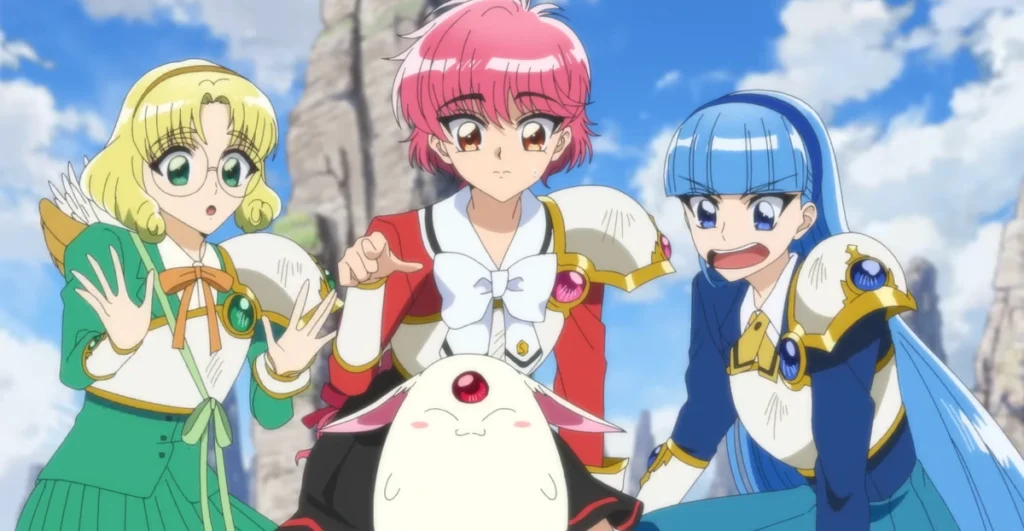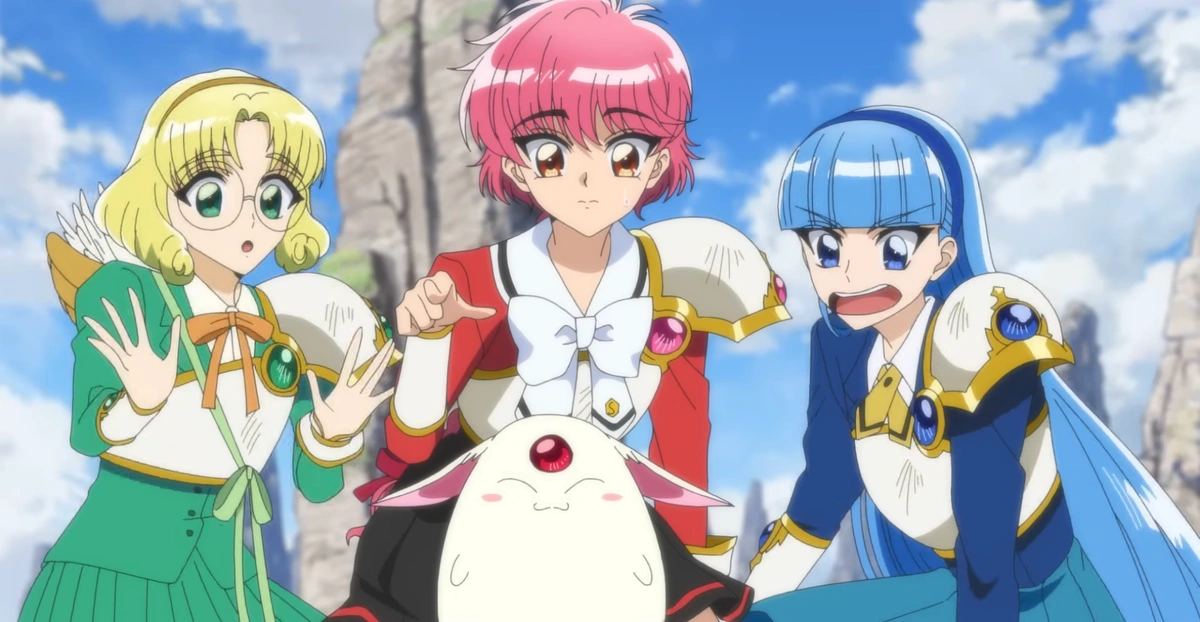
Hello everyone and welcome back to 1994! Yeah, we’ve gone back in time again and for some reason Magic Knight Rayearth is back on the telly again. I really don’t know why this time slipping stuff keeps happening here at Magical Stage but it really needs to stop.
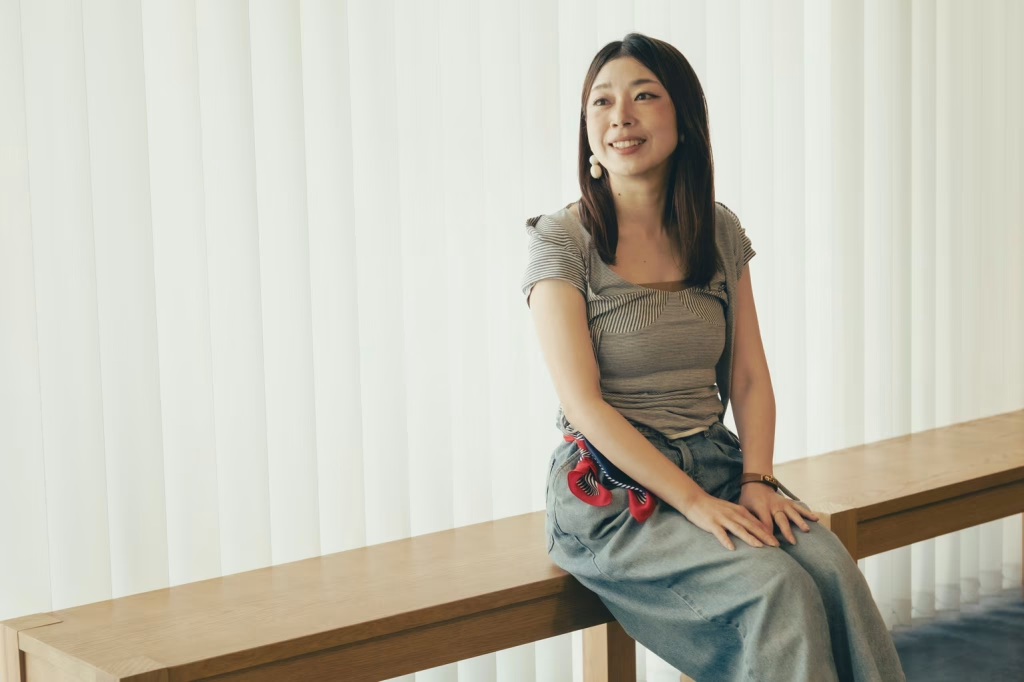
Joining us this time round, is Yui Miura, a director who got his start in the mid 00s and ended up working mostly on MAPPA anime in the 2010s. Apart from being Assistant Director on Jujutsu Kaisen and Ninja Kamui, his most notable achievement would have to be that he storyboarded Ep.40 of Chi’s Sweet Adventure. It’s important that I mentioned that because Chi is a very cute cat.
Also joining us is Seong-Hu Park, the founder and director of E&H Production, the studio currently adapting Magic Knight Rayearth once again. Park is a notable figure for being the director of Jujutsu Kaisen and its film Jujutsu Kaisen 0 while at MAPPA. He founded E&H Production in 2021. Of course, his greatest achievement is the fact that in his early career, he was an inbetweener on Onegai My Melody. To be perfectly honest, his career has been in a downward spiral since then as none of his future works have been graced with Kuromi’s presence.
While Rayearth doesn’t have Kuromi in it, it does have Mokona which is good enough I guess. Let’s read their thoughts!
Translation by “nui”, Editing by me. Magic Knight Rayearth: “Why we have to make it now” Published on mantanweb in October 2026.
Original Link: https://mantan-web.jp/article/20260927dog00m200043000a.html
Magic Knight Rayearth: “Why we have to make it now”– Interview with Director Yui Miura and Producer Seong-Hu Park
The highly anticipated new TV anime adaptation of Magic Knight Rayearth, the hit manga by creative collective CLAMP, premiered on October 7 in TV Asahi’s IMAnimation W programming block, airing every Wednesday at 11:45 PM JST. The original work is a legendary isekai adventure manga serialized in the shoujo magazine Nakayoshi (Kodansha) from 1993 to 1996. This marks the first new anime for the franchise in about 29 years since the 1997 OVA (Original Video Animation) Rayearth, and the first TV series broadcast in roughly 31 years since the previous 1994 to 1995 run.
The new Fall 2026 series is animated by E&H production, led by Seong-Hu Park, known for Jujutsu Kaisen and Jujutsu Kaisen 0 the Movie, with Yui Miura, who also worked on Jujutsu Kaisen, stepping into the director’s chair. How did they tackle a masterpiece that boasts massive popularity in both its original manga and previous anime forms? We asked Director Yui Miura and Creative Producer Seong-Hu Park.
How It Stands Apart from Contemporary “Isekai”: A Tale Essential for Today’s Audience
Interviewer: What led to the creation of the new anime project?
Seong-Hu Park: The project kicked off following a pitch by TMS Entertainment Producer Takuma Kishida. Initially, I was completely caught off guard, wondering why anyone would bring back Rayearth at this point in time. However, after presenting the concept to our studio’s internal producers, my initial skepticism quickly turned into absolute certainty that bringing Rayearth to a modern audience was essential.
The core themes of the original manga, building meaningful friendships and taking control of one’s own destiny, feel like principles that are easily overlooked today. I realized that the elements that deeply connected with our generation are precisely what we must share with today’s viewers. Despite recognizing how demanding the process would be, we fully committed, and E&H production officially assumed responsibility for the project.
Interviewer: Had you previously engaged with the original manga or watched the 1990s anime adaptation?
Park: At the time, I was living in Korea, where mecha was incredibly popular among my generation. Naturally, a series like Rayearth, which featured young girls piloting mechas, built a huge fan following there as well. Given how phenomenal the show was, from its opening sequence to the overall animation quality, I was genuinely worried about whether our team could successfully capture and deliver that same standard of quality.
Yui Miura: Prior to taking on this project, I rarely consumed manga or anime, meaning I had no personal experience with Rayearth. While I was aware of its immense popularity, notably that Naomi Tamura performed the anime’s opening theme, Yuzurenai Negai, on Kohaku Uta Gassen, that summarized the extent of my familiarity. It was only after joining as director that I first engaged with the material. To avoid being overly shaped by earlier animated versions, I chose to briefly review the original anime’s overarching plot while dedicating myself to an in-depth analysis of CLAMP’s original manga.
Interviewer: Once you ultimately experienced the series, what drew you to it?
Miura: Although isekai has become an omnipresent genre today, Rayearth stands out due to a fundamental distinction, which was a driving factor in my decision to direct it. Today’s isekai narratives frequently revolve around protagonists endowed with overpowered “cheat” abilities who easily dominate their opponents. While this predictable formula offers instant gratification that resonates with viewers, Rayearth takes a far grittier path, its heroines do not secure effortless victories.
Instead, they face genuine hardships, suffer injuries, and undergo meaningful growth as they strive to protect the world. Such narrative design is a rarity in contemporary anime. Tracing back to how the intense “willpower” themes of the 1980s evolved into a milder tone in the 1990s, I recognized that this series highlights an essential message: characters must be shown putting in real effort and enduring real pain. So, despite sharing the same overarching genre, its core themes set it apart entirely. I was convinced that reintroducing this perspective today would deeply engage audiences and serve as a refreshing breakthrough.
Interviewer: What motivated Park to select Miura to direct the new animated series?
Park: Having previously collaborated with Yui on Jujutsu Kaisen, where I assigned him key scene direction, I knew first-hand his exceptional skill at framing character acting cleanly without unnecessary movement. This approach results in compositions that are remarkably clear and accessible for viewers. At its heart, Rayearth relies on a grounded narrative and rich character drama, with the grand visual effects, mechas, and magic serving as complementary layers on top. Consequently, bringing out the characters’ intrinsic appeal through clean, readable screen direction was vital for this adaptation. Recognizing that Yui possessed the exact directorial qualities the project demanded, I offered him the role on Magic Knight Rayearth, and he accepted without a moment’s doubt.
Honoring CLAMP’s Vision: Overcoming the Challenges of Translating Iconic Artwork into Animation
Interviewer: What served as the core priority in creating the modern anime adaptation?
Park: Above all, our main priority is honoring the original source material, then building upon it with the unique strengths that animation provides. Truthfully, that direction stems more from the director’s own vision than my own.
Interviewer: Did adapting CLAMP’s exquisite artwork and sweeping narrative into animation present significant challenges?
Park: For our studio, managing the immense weight of expectations was undoubtedly the most daunting hurdle. Given the monumental popularity and viral impact of the original Rayearth manga and its classic anime adaptation, we were constantly mindful of matching that enduring legacy. Yet, observing our production staff on the floor, their deep-seated affection for Rayearth was undeniable, every single member was driven by pure enthusiasm for the material. That shared passion gradually eased the strain. I came to realize that as long as we genuinely enjoyed bringing this beloved story to life, the final product would naturally be exceptional.
During production, Yui directly invited me to oversee the opening sequence. I was initially completely shocked by the offer, wondering if I was really the right person for the job. Knowing how iconic the original series’ opening was, the pressure was high, but I eventually set that aside. By staying true to what I wanted to convey and aligning with his vision, I was able to simply enjoy the creative journey.
Interviewer: Whereas the original Heisei-era series relied on traditional hand-drawn animation, what approach is being used for this modern production?
Miura: Because the mecha elements are nearly 100% 3D, Rune God Design and Rune God Mechanical Director Hiroki Mutaguchi rendered them in greater detail than in the original manga. I consider this a major triumph and a core visual highlight of the show. Regarding character animation, the industry has seen a rise in realistic styles with simplified linework, with titles like Jujutsu Kaisen and Chainsaw Man emphasizing extensive movement. However, that approach feels ill-suited to Rayearth.
When deliberating whether to model the character designs on CLAMP’s classic style or their modern aesthetic, we ultimately chose the nostalgic art that holds deep emotional resonance for fans. Nevertheless, animating that older aesthetic presents a steep challenge for artists accustomed to modern techniques, as it features intricate line detail and relies heavily on pure drawing intuition. While 3D models can be referenced and rotated, animators must still craft the movement around the overall feel of the volume and silhouette. Many 1990s animators executed this naturally, which really highlights the incredible skill prevalent in the anime industry during that era.
Interviewer: Indeed, the Heisei adaptation brought together a stellar lineup: Atsuko Ishida handled character design, Rihiro Yamane was responsible for monster and mecha design, and Masami Obari directed the opening sequence.
Miura: With that in mind throughout production, our primary focus was carefully deciding what needed to be animated and what should remain still. Where other series might choose to animate a sequence, we deliberately opted for static shots to capture the distinct feel of the original manga. Preserving that aesthetic was our top priority.
Interviewer: What criteria were used to determine which elements to animate versus those to leave static?
Miura: It depends entirely on what the shot requires. While action naturally demands movement, standard acting sequences are a completely different matter when deciding whether to rely on static artwork or fluid motion to carry the scene. Certain series thrive on continuous movement to bring their characters to life, but for Rayearth, taking that route would be pointless if we failed to lean into the sheer quality and visual elegance of the art.
Interviewer: Are you aiming to fully highlight and leverage CLAMP’s artwork?
Miura: I believe this approach works significantly better. Adding movement occasionally yields superior results, but that is not always the case. In routine character acting, much like in live-action production, maintaining stillness can often communicate a great deal more. We were meticulous in ensuring our layouts captured the specific feel of 1990s and 2000s anime. This style aligns much more naturally and better highlights the core strengths of the original manga. For example, when complex manga narrative threads become difficult to track, animation provides clarity, allowing audiences to effortlessly realize, “Ah, that makes complete sense now”. Anticipating that this dynamic would apply to Rayearth, I made it a major focus during development. Faithfully communicating the manga’s story and emotional weight is our highest imperative. Consequently, while we include minor original additions to clarify narrative details, these are strictly intended to flesh out existing source material rather than push personal creative agendas.
Interviewer: Certain individual manga panels are provided expanded screen time to allow for a more meticulous animated depiction.
Miura: Right. It’s a question of whether a scene “can hold its own with just this drawing.” When it comes to storyboarding, it’s long been said that you should cut about once every three seconds, but if the artwork is strong enough to hold the viewer’s attention, there’s no need to cut. Drawing those moments properly is the core mission of this series. Do we want wobbly, moving everyday acting where the art breaks down, or do we want crisp, beautiful artwork? At the same time, making it a complete “freeze frame” is tough, so we’ve placed manga style screen tone spattering (a technique of flicking ink droplets onto paper) into the shots, or added subtle movement to the atmospheric backgrounds. But even that is kept to a level where it doesn’t distract from the artwork, creating an impression like you’re turning the pages of a manga. You might ask, “Why not just read the manga then?” But anime has the element of time, so by separating the parts that stand out dynamically and the parts that leave a lasting visual impression, we make it easier to understand. That’s what I wanted to do most. I don’t think we should be injecting our own ideology into this, and it’s not the kind of show that wants that anyway, so it’s best to stay as close to the source material as possible and let people experience its brilliance. If people watch the anime and then want to read the original to take their time enjoying the gorgeous art, that would be great. And if that leads them to read other works and step into the CLAMP world, that’s even better. I feel like that’s one of the things we can accomplish here.
Color Nuance and Fan Passion Driving the Production Process
Interviewer: The action sequences and magic visual effects, featuring wind, water, and fire elements, promise to be standout aspects of the anime.
Miura: As for the effects, Masataka Akai, who is producing incredibly wonderful cuts for us in-house, is just so good that we are leaving it to him. As a company, having someone that strong on the team is incredibly reassuring. The same goes for Tetsuro Moronuki, who has joined us as an Effect Animation Director, and the other effect animation directors we’ve brought on board; they’re delivering highly satisfying finishes and saving us big time. Beyond that, Character Designer and Chief Animation Director Satomi Watanabe and all the other animators are just incredibly talented. Even outside the animation staff, we’ve been heavily supported by advice from our in-house producer who is a massive fan of CLAMP’s work, as well as Kodansha’s Nozomi Matsuura. There are quite a few details, even down to a single accessory, that I completely miss, and they’ll point out, “That’s not the right color.”
Interviewer: Among all the feedback provided, which specific piece of advice stood out to you the most?
Miura: Definitely about the colors. The character’s signature colors are red for Hikaru, blue for Umi, and green for Fuu, but depending on the scene, mixing colors can make things confusing, and the color balance can literally change the meaning of a scene. So they’ll tell us, “You can’t use this color,” or “This color is wrong.” If you look at CLAMP’s art books, they assign specific meanings to the things they draw properly. If we deviate from that, there’s a strong risk it will be interpreted in a completely different way. For example, I once ordered an atmospheric background meant to make Hikaru’s red pop, but Chief Animation Director Satomi Watanabe told me, “No, I think that interpretation is wrong. Please look at the illustration book.” When I checked, it leaned toward red but with a very exquisite, nuanced color palette. My request turned out to be “wrong for the series,” so I had to apologize to the art department and have them fix it. Any mistakes born from my lack of knowledge are constantly being course-corrected by everyone. When I think about what would happen if I didn’t notice, ended up creating something with the wrong interpretation, and fans wondered, “Why did they do this?”, it gives me chills. After all, we really want to make the fans happy.
Interviewer: To conclude, what core message or experience do you aim to convey through the new Magic Knight Rayearth series?
Park: For fans who grew up reading the manga or watching the 1990s TV series, Rayearth remains a cornerstone of their youth. Introducing this story to a new generation transforms nostalgic affection into a fresh visual experience, making this the ideal moment for its core message to find an audience. Centered on fundamental values such as determining one’s own path and standing by loved ones, Rayearth offers a narrative bridge to replenish what modern life so often lacks. Our goal for this production is to let both long-time admirers and newcomers fully immerse themselves in its universe. Viewing the completed footage, the profound passion of the director, producers, and creative crew for the source material shines through, resulting in a work of truly remarkable force.
Miura: Uncertainty is a common hurdle at the start of any anime production; it is impossible to predict the final outcome, commercial success, or overall quality. However, with production completed up to Episode 11, it is deeply gratifying to see the team’s ambition grow. Their shared determination to elevate the show further and preserve its high standards is truly encouraging. Through this series, we aim to faithfully deliver the core messages embedded by CLAMP: taking ownership of your own destiny rather than bowing to fate, and never relinquishing control of your life to others.
Infused with the spirit of the original manga and fuelled by the collective passion of its creators, the new Magic Knight Rayearth anime is poised to deliver a refreshing yet warmly nostalgic experience to the Reiwa era.